Hieroglyphs vs Pictograms vs Petroglyphs: What Actually Counts as Writing?
Egyptian hieroglyphs look like pictures.
They show birds, snakes, people, buildings, tools, body parts, plants, and hundreds of other recognizable objects.
That makes it tempting to describe the script as:
picture writing
or even:
a collection of pictograms.
Both descriptions are incomplete.
Egyptian hieroglyphs form a writing system because the signs can encode language: words, consonants, grammatical elements, names, and sentences.
A picture of an owl can represent a sound.
A picture of a house can write the Egyptian word for “house.”
A seated human figure can classify a word as referring to a person without being pronounced at all.
A petroglyph, by contrast, is defined mainly by how and where an image is made: it is carved, pecked, scratched, or incised into rock.
A pictogram is defined mainly by how a picture conveys meaning.
Those categories are not interchangeable.
The key distinction is:
what a mark looks like is not the same question as how it functions.
What Makes Something Writing?
A writing system does more than communicate a general idea.
It provides conventional signs that represent language closely enough for readers who know the system to recover linguistic content.
Cambridge’s linguistic definition describes writing as a system of lasting marks used to represent an utterance so that it can be recovered without the original speaker being present.
That helps separate writing from many other visual systems.
A red traffic symbol can tell a viewer:
do not enter
without literally spelling or grammatically encoding the English words do not enter.
A drawing of a deer can indicate:
deer
hunting
a clan
a location
a sacred association
or something else entirely, depending on culture and context.
The image can communicate successfully without representing a specific spoken sentence.
Writing goes further.
It ties marks systematically to the language of a community.
That can happen through:
- sounds;
- syllables;
- whole words;
- grammatical signs;
- combinations of these.
Egyptian hieroglyphic writing does exactly that.
Hieroglyphs Are a Full Writing System
The Egyptian hieroglyphic writing system uses several kinds of signs together.
The most important categories are:
phonograms — signs that represent sounds;
logograms or word signs — signs that can represent whole words;
classifiers — unpronounced signs that help identify meaning or semantic category.
This mixed structure is why hieroglyphs cannot be reduced to pictures.
A reader does not simply look at each picture and name the depicted object.
The reader asks:
What function does this sign have here?
The same sign can behave differently in different words.
That is one of the defining features explained in how Egyptian hieroglyphs work.
A Picture Can Represent a Sound Instead of the Thing It Depicts
This is the point that most clearly separates hieroglyphic writing from simple picture communication.
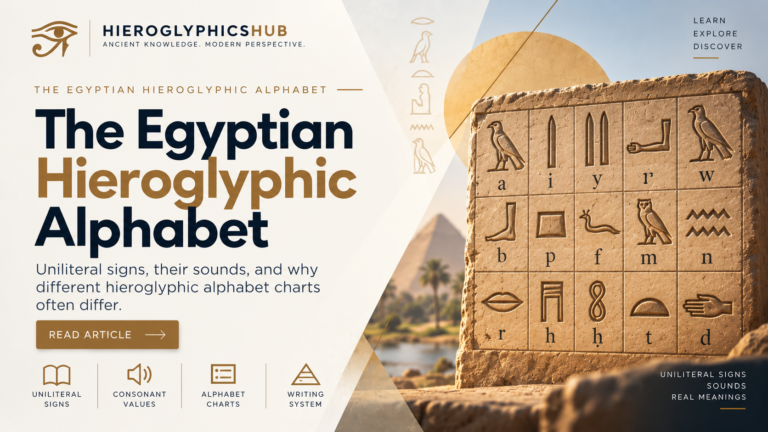
The owl sign commonly represents the consonant:
m
When it functions that way, the reader does not translate it as owl.
Likewise, the mouth sign can represent:
r
The picture supplies a conventional sound value.
This is an example of the broader rebus principle: a picture can be reused for the sound associated with its name rather than only for the object depicted.
A simple English analogy would be using a picture of an eye for the word I.
Once signs can represent conventional sounds, a script can write abstract words, grammatical forms, names, and verbs that cannot be pictured directly.
That phonetic principle is fundamental to Egyptian writing.
Some Hieroglyphs Really Can Function Like Pictures of Words
A hieroglyph can also represent the object it depicts and write the corresponding Egyptian word.
The house-plan sign can function as:
pr
“house.”
In that use it is a logogram.
A vertical stroke may accompany a logogram to signal that the sign is being read as the word for the depicted object.
So the opposite oversimplification—“hieroglyphs are purely phonetic”—is also wrong.
Egyptian writing combines lexical, phonetic, and semantic sign functions inside one conventional linguistic system.
Classifiers Look Like Pictures but Are Usually Not Read Aloud
A classifier, traditionally called a determinative, normally appears at the end of a word.
It helps identify what kind of meaning the preceding spelling has.
A seated man can classify a human being.
A town sign can classify a settlement.
A papyrus roll can classify certain abstract or written concepts.
The classifier contributes semantic information but is generally not pronounced as another part of the word.
The system is explained more fully in determinatives and classifiers.
This creates a useful three-way contrast:
picture used for sound → phonogram
picture used as a whole word → logogram
picture used to classify meaning → classifier
All three can have the same detailed pictorial style.
Function, not appearance alone, determines how the sign is read.
Are Hieroglyphs Pictograms?
Some individual hieroglyphic uses can reasonably be described as pictorial or pictographic.
The whole Egyptian writing system should not be described as merely pictographic.
A pictogram is a picture or symbol used to represent an object, idea, word, phrase, or message. Modern public-information icons work this way: they can communicate meaning without encoding the grammar or sound structure of a particular sentence.
Egyptian hieroglyphs can also use picture-based signs in meaning-bearing ways.
But the script goes much further. It can encode:
- consonants;
- grammatical endings;
- pronouns;
- verb forms;
- personal names;
- place-names;
- complete clauses.
So a better description is:
Egyptian hieroglyphs are a mixed writing system whose signs are highly pictorial in form.
The related word pictograph needs care because it has two common uses.
In general language it can mean a picture-sign much like pictogram.
In rock-art terminology, however, a pictograph is specifically a painted image on rock.
That archaeological use is different from a petroglyph, which is carved or pecked into rock.
A Petroglyph Describes a Rock-Carving Technique, Not a Writing System
A petroglyph is an image or design made by pecking, scratching, engraving, carving, or abrading a rock surface.
The term primarily describes:
material
and:
production technique
It does not automatically tell us whether the marks encode language.
Petroglyphs can show people, animals, tracks, geometric forms, scenes, or symbols whose meanings are uncertain. They may preserve stories, ritual meanings, identity, territorial information, memory, or other communication.
But communication alone is not the same as writing.
A carved image of a deer may be deeply meaningful without representing a recoverable spoken word or sentence.
The reverse is equally important:
carving on rock can absolutely be writing.
An alphabetic inscription cut into stone is writing.
A hieroglyphic text carved on an Egyptian temple wall is writing.
The physical act of carving does not decide the linguistic category.
Ask two separate questions:
How was the mark made?
Does it belong to a conventional system that encodes language?
Egyptologists normally call formal carved Egyptian texts inscriptions, not petroglyphs, because the terms come from different archaeological traditions.
But what makes the hieroglyphic text writing is its linguistic system, not the fact that it is carved.
A Hieroglyph Is Not Just Any Ancient Symbol
The word hieroglyph is often used casually for any mysterious-looking ancient mark.
In Egyptology, however, a hieroglyph is a sign belonging to the Egyptian hieroglyphic script.
A spiral carved on rock is not automatically a hieroglyph, and neither is every prehistoric animal image or modern Egyptian-style symbol.
The term belongs to a specific writing tradition whose signs and functions were conventionalized across Egyptian history.
The basics are covered in what Egyptian hieroglyphics are.
Looking Like an Object Does Not Tell You How a Hieroglyph Should Be Read
A sign’s picture is not a translation key.
The mouth sign, for example, can represent r rather than the lexical meaning “mouth.”
More generally, a sign may function as a word sign, a sound, part of a multiconsonantal spelling, or a classifier.
The reader identifies that function from the word and context.
This is also why phonetic complements matter: apparently redundant signs can reinforce sounds already contained in a larger sign.
Early Egyptian Marks Show Why the Boundary Can Be Difficult
At the beginnings of writing, the boundary between picture, symbol, and writing sign can be difficult to identify archaeologically.
Predynastic Egyptian objects contain marks whose exact status remains uncertain. A symbol may communicate ownership, place, quantity, or ritual identity without fully encoding ordinary language.
As writing developed, Egyptian signs became increasingly standardized in direction, phonetic value, word spelling, and arrangement.
The important transition is therefore not simple picture → sophisticated picture but visual mark → conventional sign inside a language-encoding system.
The history of Egyptian hieroglyphics is best understood with that distinction in mind.
A Simple Test: Can the Marks Encode Something You Cannot Draw?
One useful test for a writing system is whether it can encode language beyond directly depictable objects.
Consider concepts such as:
because
his
to give
good
yesterday
the name of a specific person
A purely pictorial system struggles if every sign must depict its meaning directly.
A writing system can use sounds, grammatical patterns, or conventional word signs to represent such material.
Egyptian hieroglyphs can do that.
They can record:
who did something
to whom
with what grammatical form
under which name or title
inside a complete sentence
That is much more than a picture sequence.
Why This Distinction Matters When Reading Egyptian Monuments
Egyptian monuments often combine:
large-scale images
and:
hieroglyphic text
The two can look visually similar because the hieroglyphs themselves are miniature pictures.
But their functions differ.
A large figure of a king offering to a god belongs to the scene.
A small king-sign inside a written column may serve a lexical, phonetic, or semantic function.
The image and the text can reinforce each other without being the same communication system.
That is why you cannot “translate” an Egyptian scene by naming every depicted object.
And you cannot translate the inscription by treating every sign as a miniature scene.
The reader has to know which visual field is writing and then analyze how each hieroglyph functions inside that writing.
Quick Comparison
| Term | What it primarily describes | Must encode language? | Typical example |
|---|---|---|---|
| Hieroglyph | A sign in the Egyptian hieroglyphic writing system | Yes, as part of the system | Owl sign used for m |
| Pictogram | A picture-symbol conveying an object, idea, word, or message | No | Public-information icon |
| Pictograph | Either a picture-sign or, in rock-art usage, a painted rock image | No | Painted figure on a rock shelter |
| Petroglyph | An image/design carved or pecked into rock | No | Pecked animal or geometric rock image |
| Inscription | Writing placed on a durable surface | Yes | Hieroglyphic text carved in stone |
| Logogram | A writing sign representing a whole word | Yes | House sign writing pr, “house” |
| Phonogram | A writing sign representing sound | Yes | Owl sign writing m |
| Classifier | A semantic sign added to a written word | Part of writing, but usually unpronounced | Human sign classifying a person-word |
The categories can overlap at the level of physical appearance.
A sign can be a highly pictorial image and a phonogram.
A carved mark can be an inscription.
A picture-sign can become part of a true writing system.
The correct classification depends on function.
Do Not Ask “Is It a Picture?”—Ask “What Does It Do?”
Egyptian hieroglyphs are visually pictorial but linguistically sophisticated.
They combine signs for sounds, whole words, and semantic classification.
Pictograms communicate through picture-symbols but do not necessarily encode a specific language.
Petroglyphs are defined primarily by being carved into rock and may be symbolic, pictorial, communicative, or—in some cases—part of writing.
So the decisive question is not:
“Does this mark look like something?”
It is:
“Does this mark belong to a conventional system that represents language, and what function does it have inside that system?”
For the HieroglyphicsHub translator, that distinction is fundamental.
A translator cannot treat every recognizable image as a word.
It has to determine whether a sign is phonetic, logographic, classificatory, or part of a non-textual scene.
That is the difference between identifying pictures and actually reading Egyptian writing.