Hieroglyphs vs Hieratic: Same Language, Different Egyptian Scripts
Place a carefully carved temple inscription beside an Egyptian letter written rapidly in ink on papyrus and they can look as though they belong to different writing systems.
Often, they do not.
The formal inscription may be written in hieroglyphs. The handwritten document may be written in hieratic. Both could represent the Egyptian language, and both belong to the same broader writing tradition. Yet hieratic was not simply a careless version of hieroglyphs. It developed as a conventional cursive script with recognizable sign forms, ligatures, abbreviations, scribal habits, and historical styles of its own.
That distinction matters because the familiar summary — “hieroglyphs were for monuments, hieratic was shorthand” — is only partly useful. It captures the difference in speed and appearance, but it understates how central hieratic was to Egyptian literacy and how much specialist knowledge can be required to move from a handwritten document to a readable transcription.
Hieroglyphs and Hieratic at a Glance
| Feature | Hieroglyphic writing | Hieratic writing |
|---|---|---|
| Basic character | Formal, pictorial Egyptian script | Cursive Egyptian handwriting tradition |
| Main strength | Formal display, monumental and visually integrated writing | Fast, practical writing with ink |
| Common surfaces | Temple and tomb walls, stelae, objects, stone, but also painted and written surfaces | Papyrus, ostraca, wooden tablets and other portable surfaces; also attested on additional materials |
| Visual form | Signs often remain clearly pictorial | Signs can be highly simplified, abbreviated, or joined |
| Direction | Horizontal or vertical; left-to-right or right-to-left depending on orientation | Always right-to-left; early columnar layouts later gave way largely to horizontal lines |
| Sign relationships | Individual signs are often visually discrete | Ligatures and connected forms are common |
| Typical uses | Monumental inscriptions, formal religious texts, labels, titles and display writing | Letters, accounts, administration, literature, ritual, legal and learned texts |
| Language | Egyptian across different historical stages | Egyptian across different historical stages |
| Modern study | Signs can often be read directly in their formal forms | Manuscripts are commonly transcribed into normalized hieroglyphs before transliteration and translation |
The strongest contrast is therefore not language versus language. It is formal pictorial writing versus a long-lived cursive writing practice.
They Are Scripts, Not Two Separate Languages
“Hieroglyphic” and “hieratic” describe ways of writing Egyptian.
An Egyptian word could be represented in formal hieroglyphs or in a corresponding hieratic spelling. Its vocabulary and grammar belong to Egyptian; the script determines how that language appears on the writing surface.
That does not mean every hieroglyphic and hieratic text belongs to exactly the same stage of Egyptian. The language changed over thousands of years, and Old Egyptian, Middle Egyptian, Late Egyptian, Demotic, and Coptic are not linguistically identical. A hieratic manuscript from one period can therefore differ from a hieroglyphic text of another period for reasons that go beyond script.
The important point is narrower: hieratic did not constitute a separate language simply because its signs looked different.
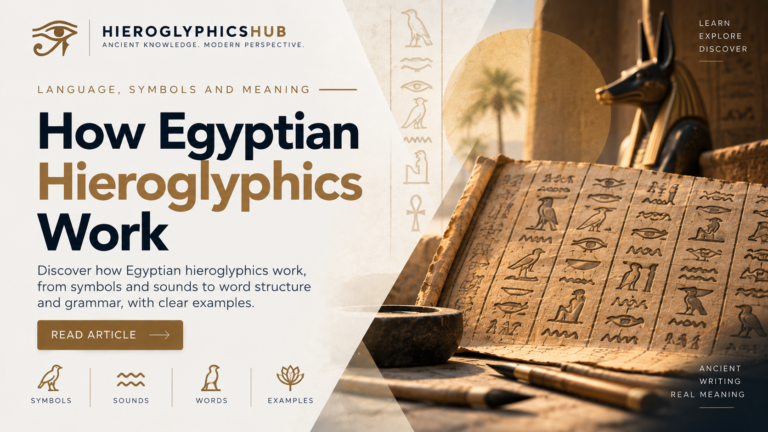
This is why the principles explained in how Egyptian hieroglyphics work remain relevant when studying hieratic. Phonetic values, word spellings, classifiers, and grammar still matter. What changes dramatically is the visual form in which those elements are written.
How a Pictorial Sign Becomes a Cursive Form
Calling hieratic “messy hieroglyphs” misses the development of a real scribal convention.
A formal hieroglyph may preserve enough detail for a modern viewer to recognize a bird, hand, seated person, architectural element, or other object. A hieratic equivalent can reduce that image to a small number of strokes. Curves may become angular, details may disappear, and frequently used signs may become compact enough that their original pictorial form is no longer obvious.
The writing tool matters. Ink applied quickly with a brush encourages movements very different from carving a sign into stone or carefully painting a formal inscription. Repeated use also encourages economy: forms that a scribe writes constantly tend to become efficient.
Hieratic went further than simple simplification. Signs could be abbreviated, and combinations could be written as ligatures, joining elements that formal hieroglyphic writing would normally leave visually more distinct. Those conventions had to be learned.
The result is a script that remains historically related to hieroglyphs without functioning as a handwriting font that mechanically turns each formal glyph into a faster version of itself.
For a specialist overview of this development, materials, ligatures, historical stages, and palaeographic study, Ursula Verhoeven's Hieratic in the UCLA Encyclopedia of Egyptology provides a useful scholarly reference.
Why Egypt Needed Hieratic
Formal hieroglyphs are extremely effective when writing also serves as display.
A temple wall can accommodate carefully shaped signs integrated with architecture and imagery. A royal or funerary monument can use orientation, spacing, scale, and composition as part of the inscription.
An account, letter, or administrative note has a different practical requirement: it needs to be written efficiently.
Reproducing a detailed owl, viper, hand, reed leaf, or human figure every time would slow a scribe working through lists, correspondence, calculations, or lengthy manuscripts. A cursive script allowed the underlying writing system to be used at the speed demanded by everyday and professional scribal work.
But efficiency did not confine hieratic to mundane bookkeeping. The same script carried literature, religious compositions, medical and mathematical material, funerary texts, and learned writing.
The contrast is therefore not sacred hieroglyphs versus unimportant hieratic. Hieroglyphs excelled in formal and monumental presentation; hieratic became indispensable to manuscript and documentary culture.
What Egyptians Wrote in Hieratic
Hieratic survives in documents that reveal areas of Egyptian life monumental inscriptions rarely preserve in the same form.
Letters can contain instructions, disputes, requests, family concerns, or administrative business. Accounts record commodities and labor. Ostraca preserve notes, exercises, drafts, and shorter texts. Papyrus manuscripts transmit literature, ritual material, medicine, mathematics, and other specialist knowledge.
Common hieratic contexts include:
- letters and correspondence;
- accounts, inventories, and administrative records;
- legal documents;
- literary compositions;
- scribal exercises;
- medical and mathematical texts;
- funerary and ritual manuscripts;
- notes on ostraca;
- texts on papyrus and wooden writing surfaces.
The script therefore gives us more than another graphic form of Egyptian. It preserves the routines of writing: correction, abbreviation, rapid execution, individual hands, and the practical organization of documents.
Why the Name “Hieratic” Can Mislead
The modern term hieratic ultimately comes through Greek and carries the idea of “priestly” writing.
That label fits the script's later history better than its entire career.
When Demotic increasingly took over many documentary and everyday functions during the first millennium BCE, hieratic became more strongly associated with religious, funerary, literary, and learned contexts. To later observers, describing it as priestly made sense.
Projecting that meaning backward is misleading.
Earlier hieratic was not a specialist script restricted to priests. It was used for administration, accounts, correspondence, literature, and many other forms of writing. Its historical role changed as other scripts emerged and the division of scribal labor changed.
“Priestly script” is therefore a description of a later association, not a complete definition of hieratic.
Reading Direction: A Clear Practical Difference
Formal hieroglyphic writing is flexible in direction.
An inscription may run horizontally or vertically, from left to right or from right to left. Human and animal signs normally face toward the beginning of the text, helping the reader determine where to start.
Hieratic is more restricted: it is written from right to left.
Its layout nevertheless changed over time. Early hieratic could be organized in vertical columns, while horizontal right-to-left lines became increasingly dominant.
This difference matters when moving from textbook hieroglyphs to manuscripts. A learner accustomed to hieroglyphs arranged left-to-right for convenience cannot carry that visual habit unchanged into a hieratic document.
The Egyptian language may be familiar; the navigation of the page is different.
Material Shaped the Scripts Without Creating an Absolute Rule
A common shortcut says:
hieroglyphs = stone hieratic = papyrus
The association is real, but the rule is too rigid.
Hieroglyphs could be painted or written rather than carved. Hieratic was strongly associated with ink and portable writing surfaces, but it was not limited exclusively to papyrus.
What matters more is the relationship between material, tool, purpose, and graphic style.
Stone allows durable, carefully executed display writing. Papyrus, pottery fragments, and wooden writing surfaces favor fluent strokes and efficient use of ink. Those physical conditions helped shape the appearance of the scripts, but the writing material by itself does not automatically identify which script is present.
Hieratic Has a History, Not One Universal Hand
Once hieratic had become a mature scribal tradition, its forms continued to change.
Old Kingdom, Middle Kingdom, and later hieratic are not visually interchangeable. Administrative hands can differ from more formal book hands. Frequently written signs can acquire period-specific abbreviations, and individual scribes introduce personal habits of execution.
This historical variation is where palaeography becomes essential.
A reader may need to decide whether an unusual group is a known period form, a ligature, an abbreviation, an individual scribal habit, damage to the manuscript, or a different sign entirely. Comparison with securely dated manuscripts can also help date a text or identify a scribal tradition.
Knowing hieroglyphs therefore gives a student an important linguistic foundation but does not automatically confer fluency in hieratic. The additional skill is recognizing handwritten forms across periods and hands.
The two kinds of knowledge reinforce each other. Egyptian vocabulary and grammar can make one reading more plausible than another, while the palaeographic evidence can force a reader to reject an attractive linguistic guess.
That is why hieratic reading is not reducible to a conversion chart.
Why Scholars Transcribe Hieratic Into Hieroglyphs
A scholarly edition of a hieratic text may present neat hieroglyphs even though the original document contains cursive handwriting.
That stage is transcription.
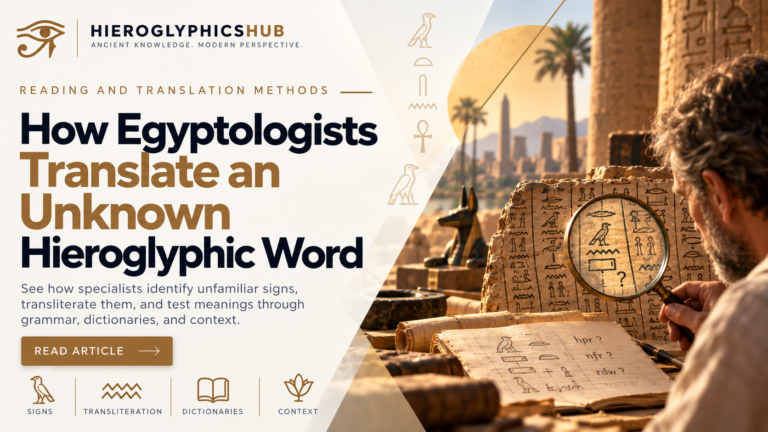
The editor identifies the hieratic forms and represents the underlying signs in normalized hieroglyphic form. The text can then be transliterated into Egyptological notation and translated.
The sequence may therefore look like:
hieratic manuscript → hieroglyphic transcription → transliteration → translation
Each stage preserves something different.
The manuscript preserves the actual handwriting. The hieroglyphic transcription makes sign identity easier to inspect. The Egyptological transliteration represents linguistic values in scholarly characters. Translation interprets the Egyptian language.
A normalized transcription is extremely useful, but it is not a substitute for the original manuscript when the research question concerns handwriting. Ligatures, spacing, corrections, abbreviations, stroke forms, and scribal habits can disappear or become less visible when the text is normalized.
Digital Text Shows the Same Distinction
Modern digital treatment makes the relationship especially clear.
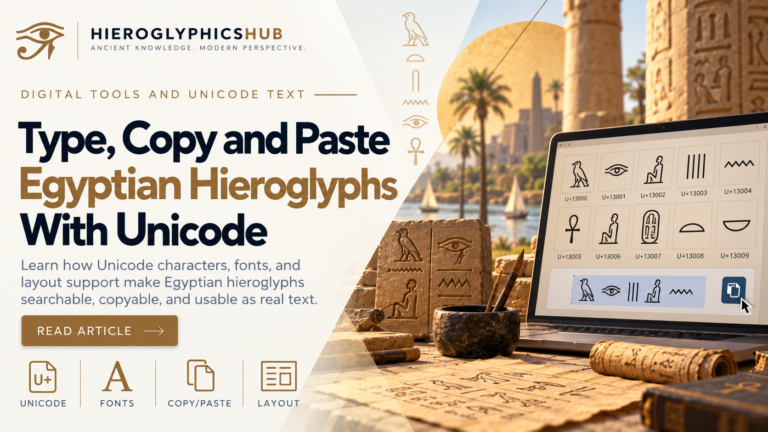
Egyptian hieroglyphs have encoded characters and formatting mechanisms that allow formal sign sequences to be represented digitally. Historical hieratic handwriting, however, contains too much graphic variation to be treated simply as a separate one-to-one keyboard equivalent for every manuscript form.
For linguistic work, hieratic texts are therefore commonly represented through normalized hieroglyphic transcription.
That is useful for searching, comparison, transliteration, and textual analysis, but it also creates an important limit:
digital transcription records which signs the scholar has identified; it does not reproduce the manuscript's handwriting.
A palaeographic question still requires the original or a faithful image of it.
Hieratic and Demotic Overlapped Rather Than Forming a Simple Replacement Chain
Egyptian script history is sometimes reduced to:
hieroglyphs → hieratic → Demotic
That sequence can imply that one script disappeared before the next began.
The reality is more complicated.
During the first millennium BCE, more cursive documentary traditions developed into forms generally grouped under Demotic, which increasingly took over legal, administrative, and everyday functions. Hieratic did not vanish. Its role narrowed, and it remained important in religious, funerary, literary, scientific, and learned settings well into later periods.
Hieroglyphs also remained in use.
The scripts therefore overlapped, while their social and textual functions changed.
This later division of labor helps explain why hieratic eventually acquired its strong priestly association even though its earlier use had been much broader.
The Two Scripts Preserve Different Evidence Beyond the Words
A hieroglyphic monument and a hieratic manuscript may encode related linguistic material while preserving different kinds of historical evidence.
Formal hieroglyphic writing can preserve deliberate sign arrangement, orientation toward figures, symmetry, pictorial detail, color, and integration with architecture or relief.
A hieratic manuscript can preserve handwriting speed, corrections, abbreviations, document layout, changes of hand, individual scribal habits, and the practical organization of written work.
Those features can help researchers investigate questions that are not visible in translation alone:
- When was a manuscript probably written?
- Did more than one scribe work on it?
- Does its hand belong to a recognizable school or period?
- Was the text copied carefully or written rapidly?
- Which abbreviations or ligatures were conventional in that context?
The script itself is therefore evidence, not merely a container for words.
Why the Difference Matters for Translation
Once the underlying Egyptian signs are securely identified, much of the same linguistic analysis used for hieroglyphic texts applies: vocabulary, grammar, phonetic values, classifiers, and context still determine meaning.
The difficult part is often reaching that secure identification.
Formal hieroglyphs can frequently be matched directly against sign lists or encoded characters. A cursive hieratic group may require palaeographic comparison before the reader can even decide which signs are present. Damage, abbreviation, ligature, and handwriting variation can leave more than one plausible reading.
This distinction is important for a hieroglyphics translator as well. A tool can process identified hieroglyphic signs or structured text differently from an original handwritten hieratic manuscript. Reliable translation of the latter may first require specialist transcription.
Treating both inputs as though they were merely different fonts would erase the hardest part of reading hieratic.
The Most Useful Distinction
Hieroglyphic and hieratic writing share a linguistic foundation, but they belong to different scribal practices.
Hieroglyphs preserve Egyptian writing in a formal, pictorial form that could become part of monuments, objects, architecture, and carefully presented manuscripts.
Hieratic turned the same broader writing tradition into a practical cursive system capable of carrying correspondence, administration, literature, ritual, technical knowledge, and everyday scribal work.
Its signs became simplified, joined, abbreviated, and historically variable because real people were writing them rapidly with real tools on real surfaces. Those changes created a script that could not be mastered simply by knowing what the formal hieroglyphs looked like.
One tradition made Egyptian writing exceptionally powerful as display.
The other made it workable as handwriting.
Ancient Egyptian literacy depended on both.