How Egyptian Hieroglyphics Work
Egyptian hieroglyphics work by combining signs that can represent sounds, words, and semantic information within the same writing system.
A single sign may contribute one consonant, several consonants, a complete word, or information that helps clarify the meaning of a word. Additional signs can reinforce pronunciation or identify the semantic category of an expression. The signs are then arranged into visually organized groups that can be read in different directions.
This makes Egyptian hieroglyphic writing fundamentally different from a modern alphabet in which letters primarily represent individual sounds.
To understand a hieroglyphic inscription, you therefore need to determine not only what each sign depicts, but what function the sign has in that particular context.
Start with the sound value
The phonetic side of Egyptian writing is one of its most important foundations.
Egyptian hieroglyphic signs can represent consonantal values. Some represent a single consonant, while others represent two or three consonants. UCL’s overview of the writing system groups these as one-consonant, two-consonant, and three-consonant signs.
Egyptian writing generally does not record vowels in the way modern English spelling does. Egyptologists consequently use transliteration to represent the consonantal structure of Egyptian words in a modern scholarly notation.
This gives a beginner an important first principle:
A hieroglyph is not necessarily a picture being read for its visual meaning. It may be functioning as a sound sign.
A sign depicting a mouth, for example, can be used for the sound associated with the Egyptian word for “mouth.” Once that phonetic value is established, the sign can participate in other words where the same sound occurs.
The visual image remains the same. Its role in the written word changes.
One sign can represent one, two, or three consonants
The simplest phonetic signs represent a single consonant.
Egyptian also has signs representing combinations of two or three consonants. These are commonly called biliterals and triliterals.
That creates an immediate difference from the way an English reader might approach an alphabet.
Suppose a word contains three consonants. Egyptian does not necessarily need three separate one-consonant signs to represent them. A single triliteral sign may already carry the complete consonantal sequence.
The reverse can happen as well. A word containing a multiliteral sign may include additional signs that reinforce part of its pronunciation.
The system therefore allows scribes to combine different kinds of phonetic information within one spelling.
Why a word may contain more signs than its sounds require
This is where phonetic complements become important.
A phonetic complement is a sign added to reinforce part of the phonetic value of another sign. It does not necessarily introduce a new sound that was absent from the preceding sign.
Imagine that a two-consonant sign represents a sequence of sounds. A following one-consonant sign may repeat the second consonant. The spelling now contains more visible signs than the basic consonantal sequence would seem to require.
To a modern reader, this can look redundant.
Within Egyptian orthography, the additional sign provides useful information about how the written group should be read. The University of Chicago’s teaching material illustrates this relationship between multiliteral signs and phonetic complements.
This is one reason that counting signs is not enough to determine the number of sounds in an Egyptian word.
A sign can write a word instead of its sounds
Phonetic writing is only one part of the system.
Egyptian also uses signs logographically, meaning that a sign can represent the word or concept associated with what it depicts.
A house sign can represent “house” as a word rather than merely supplying a sound. A mouth sign can likewise represent the word for mouth when used in its logographic role.
The same visual sign can therefore participate in writing at different levels.
It can represent:
- A sound
- A sequence of consonants
- A complete word
- Semantic information
The surrounding spelling and the sign’s position help determine which role is intended.
Oxford’s research on Egyptian writing describes the combination of logographic and phonographic writing and notes that multiliteral signs could be used in several functions, including phonograms, logograms, phonetic complements, and determinatives.
Determinatives add meaning without being pronounced
A determinative is a non-phonetic sign used to provide semantic information about a word.
This becomes particularly useful because Egyptian writing generally records consonantal information rather than spelling vowels explicitly. Different words can therefore have similar consonantal patterns.
A determinative can help the reader understand what category of meaning is intended.
A word referring to a person, for example, may receive a human determinative. A word associated with movement may have a sign associated with movement or action. The determinative contributes to interpretation without normally contributing to the word’s pronunciation.
UCL describes determinatives as signs placed with words to indicate their general significance, while other Egyptological treatments describe them as semantic classifiers that can help distinguish words with similar phonetic structures.
The position of a determinative can therefore provide information that an English reader might expect to find in the spelling itself.
The same sign does not always perform the same job
One of the easiest mistakes for beginners is to assign a permanent meaning to every sign.
Egyptian hieroglyphs do not work that way.
A sign depicting an animal, object, or body part may be used as a logogram in one context and as a phonogram in another. A sign that normally represents a word can also participate in a phonetic spelling.
The writing system depends on function within context, not just visual identity.
This is why a sign list is useful but insufficient. A sign list can tell you what values and uses a sign may have. It cannot, by itself, determine what the sign is doing in every inscription.
The reader has to examine the complete written group.
Egyptian words are built from interacting pieces
An Egyptian word can contain several kinds of signs working together.
A simplified spelling might involve:
phonetic sign + phonetic complement + determinative
Another word might use:
logogram + phonetic complement
Another could be written primarily through phonetic signs.
There is no requirement that every word contain the same combination.
The important point is that Egyptian orthography allows phonetic and semantic information to coexist within the same written word.
A reader therefore moves through several questions:
- What sound value can each sign provide?
- Is one of the signs functioning as a word sign?
- Are any signs serving as phonetic complements?
- Is there a determinative?
- What Egyptian word fits the resulting information?
- What does that word mean in its grammatical context?
Translation begins after those questions have been considered, not before.
Context resolves what individual signs cannot
Egyptian writing contains information that becomes meaningful only when signs are considered together.
A sequence of consonants can correspond to more than one lexical possibility. A determinative may narrow the semantic field. A grammatical ending or construction may identify the function of a word within a sentence.
This is why reading a hieroglyphic inscription resembles solving several connected problems rather than looking up every picture individually.
The written signs provide evidence.
The vocabulary identifies possible words.
The grammar establishes relationships.
The context helps determine which interpretation fits.
The process is cumulative.
Grammar changes the meaning of the written group
Words do not exist in isolation when they appear in a sentence.
Egyptian grammar determines how words relate to one another, and the same lexical item can perform different roles depending on the construction in which it occurs.
A translator therefore cannot reliably take an English sentence, replace each word with an Egyptian dictionary entry, and assume that the result is grammatically Egyptian.
The Egyptian expression has to be constructed according to Egyptian linguistic rules.
This distinction becomes especially important when moving from individual vocabulary to complete sentences.
A dictionary can tell you that an Egyptian word exists. It cannot automatically tell you how that word should be placed, inflected, or interpreted within every sentence.
Word order is part of the writing system’s meaning
Egyptian sentences do not necessarily follow modern English word order.
The language developed its own grammatical structures, and different constructions can place elements in different positions.
A translator working with a sentence therefore has to consider the relationship between the words rather than treating the English order as a fixed blueprint.
This also explains why a grammatically meaningful hieroglyphic sentence may look quite different from the English sentence used to express the same idea.
The goal of translation is to preserve meaning, not to preserve the physical position of every modern word.
Hieroglyphs are arranged as visual groups
Egyptian scribes did not simply write signs in a long uninterrupted line.
Signs could be arranged into compact groups, with smaller signs positioned beside or above larger ones. UCL’s teaching material describes the writing system in terms of these individual signs and their functions, while modern instruction in Middle Egyptian also emphasizes the harmonious grouping of signs into visual blocks.
This arrangement has both practical and visual consequences.
A group of signs can occupy a rectangular space even when the individual signs have very different shapes. Scribes could adjust the arrangement to create balanced compositions without changing the underlying linguistic sequence.
The visual layout is therefore not merely decoration added after the language has been written.
It is part of how hieroglyphic writing is presented.
Which direction are hieroglyphs read?
Hieroglyphs can be written horizontally or vertically, and horizontal inscriptions can run in either direction.
The orientation of people and animals is one of the most useful clues for determining the reading direction. A figure generally faces toward the beginning of the text.
This means that the direction of the signs themselves can tell you where to start reading.
A group of human or animal figures facing left will normally indicate a reading direction toward the left, while figures facing right indicate the opposite direction.
Vertical columns can also be read according to the orientation and arrangement of the inscription.
The result is a writing system whose direction is flexible while remaining visually structured.
Why sign orientation matters
Orientation is not simply a matter of turning a modern sentence around.
The position and facing direction of a sign can form part of the visual composition. Egyptian scribes arranged signs carefully, and the direction of figures helped integrate the written message with the surrounding architectural or artistic space.
This is particularly visible on temples, tomb walls, statues, and other monumental surfaces.
A modern digital representation therefore needs to preserve more than the identity of individual signs. It also needs to account for their intended arrangement and direction.
Hieroglyphic writing can combine sound and image in one word
One of the most interesting features of the script is the way visual and phonetic information can coexist.
A sign may depict an object while simultaneously contributing a sound to a word. Another sign may represent the word itself. A determinative can then clarify its semantic category.
The written result can consequently communicate on several levels at once.
The British Museum’s account of Champollion’s decipherment highlights this mixed nature of Egyptian writing. Champollion recognized that phonetic signs could appear alongside signs representing complete words and determinatives, an insight that was essential to understanding how the script worked.
This mixed system is also why the script was difficult to decipher before the nineteenth century.
A purely pictorial interpretation could not explain all the evidence.
A purely alphabetic interpretation could not explain it either.
Egyptian writing required both.
Why Egyptian hieroglyphics are not Egyptian “emojis”
Modern comparisons between hieroglyphs and emojis can make the subject approachable, but the comparison stops being useful when it suggests that the signs simply communicate pictures or ideas.
An emoji can represent an emotion, object, or concept without functioning as part of a full historical language system.
Egyptian hieroglyphs were integrated into the grammar and vocabulary of Egyptian.
They could record names, titles, actions, relationships, religious ideas, administrative information, and many other forms of language.
The visual appearance is only one layer of the system.
How scribes handled ambiguity
A writing system that emphasizes consonants needs ways to distinguish words that may look similar in their basic phonetic structure.
Determinatives were one important solution.
Phonetic complements provided another form of clarification by reinforcing parts of a word’s written pronunciation.
The lexical and grammatical context supplied still more information.
Egyptian writing therefore did not rely on one mechanism to make every word unambiguous. Several kinds of information could work together.
That layered approach is part of what makes the system efficient despite its limited representation of vowels.
How the writing system developed
Egyptian hieroglyphic writing was not created in its fully developed classical form overnight.
Writing appears in Egypt by around the late fourth millennium BC, and the script developed as Egyptian society and language became more complex. The British Museum places the emergence of Egyptian writing around 3250 BC and traces hieroglyphic use across thousands of years.
The earliest texts do not provide the same linguistic evidence as later fully grammatical Egyptian texts. The University of Chicago notes that the earliest hieroglyphic material includes names, labels, and short accounts, with recognizable Old Egyptian grammar emerging later.
Over time, scribes developed increasingly sophisticated ways of representing Egyptian speech and meaning.
Later Egyptian writing also existed alongside more cursive scripts, particularly hieratic and eventually demotic.
Hieroglyphs and hieratic did the same job in different forms
Hieroglyphic and hieratic writing both represented Egyptian, but their physical forms and common uses differed.
Hieroglyphs remained particularly important for formal inscriptions and monumental contexts.
Hieratic used simplified, cursive versions of hieroglyphic signs and was better suited to writing quickly with ink on materials such as papyrus and ostraca. The University of Chicago describes hieratic as a cursive script derived from hieroglyphic signs and used for handwritten material.
The relationship demonstrates an important principle:
A writing system can have different visual forms without becoming a different language.
The language is Egyptian. The script and medium can vary.
What decipherment revealed about the system
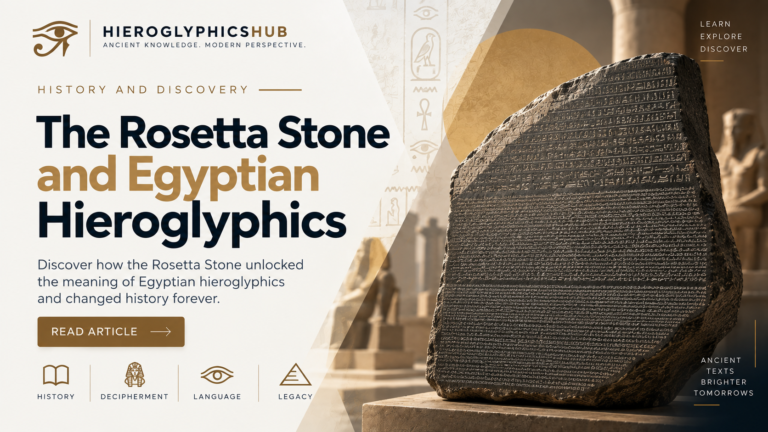
The modern understanding of hieroglyphics was shaped decisively by the decipherment work of Thomas Young and Jean-François Champollion.
The Rosetta Stone provided a parallel inscription in hieroglyphic, Demotic, and Ancient Greek. Young identified phonetic elements in royal names, while Champollion expanded the analysis and demonstrated the broader mixed nature of Egyptian writing.
Champollion’s work showed that the signs could not be reduced to one simple principle.
They could represent sounds.
They could represent words.
They could clarify meaning.
And these functions could appear together.
That discovery transformed hieroglyphic writing from an apparently mysterious collection of images into a readable representation of the Egyptian language.
How to approach an Egyptian hieroglyphic word
When faced with an unfamiliar word, a useful approach is to work from the writing toward the language.
First, establish the reading direction.
Look at the orientation of people, animals, and other directional clues.
Next, identify the signs.
Determine which signs are present and consider their possible phonetic and semantic values.
Then look for the structure of the spelling.
Ask whether a sign is functioning as a phonogram, logogram, phonetic complement, or determinative.
Reconstruct the consonantal information.
Combine the relevant phonetic values rather than assigning an English letter to each sign automatically.
Identify the Egyptian word.
Compare the resulting information with Egyptian vocabulary and the surrounding context.
Interpret the grammar.
If the word appears in a sentence, determine what role it plays and how it relates to the other elements.
Translate the expression.
Only after the linguistic structure has been considered should the complete meaning be established.
This sequence is far more reliable than reading the pictures individually.
What this means for modern hieroglyphic translation
A modern translator faces the same fundamental distinction.
Turning English letters into Egyptian signs is a phonetic conversion.
Finding an Egyptian lexical expression for an English concept is translation.
Producing that expression in properly organized hieroglyphic writing requires another stage: selecting the appropriate signs and arranging them according to Egyptian orthographic conventions.
These operations can overlap, but they should not be treated as identical.
That distinction is especially important for modern names and concepts that did not exist in ancient Egypt. A phonetic representation can be useful without claiming that the exact modern expression was an attested Egyptian word.
A translator that acknowledges those differences can communicate its results more honestly.
The key to understanding Egyptian hieroglyphics
Egyptian hieroglyphic writing becomes much easier to understand once the signs stop being treated as isolated pictures.
The writing system brings together:
- Phonetic signs for consonantal sounds
- Logograms for words
- Phonetic complements that reinforce pronunciation
- Determinatives that clarify meaning
- Grammar that connects words into expressions
- Visual arrangement that organizes signs into readable groups
- Reading direction that determines how those groups are approached
None of these elements operates completely independently.
A reader identifies the signs, determines their functions, reconstructs the linguistic material, considers the grammar and context, and then arrives at an interpretation.
That is the underlying logic that turns a collection of pictures into written language.
If you want to move from understanding the system to actually approaching an inscription, continue with How to Read Egyptian Hieroglyphics.