Determinatives: The Silent Hieroglyphs That Help Reveal Meaning
Ancient Egyptian writing often tells you something about a word that its pronunciation alone does not.
A group of hieroglyphs may supply the consonants of a word, followed by another sign that is not pronounced at all. That final sign might show a person, a settlement, walking legs, food, a building, a deity, or something associated with an action.
It is there to help classify what the word means.
These silent signs are traditionally called determinatives. Many modern discussions also call them classifiers, a term that describes their role more precisely: rather than supplying another sound, they place a word within a semantic category.
That may sound like an optional aid added for readers. It is more fundamental than that. Determinatives reveal how Egyptian writing combines phonetic and semantic information in the same written word.
Once you learn to notice them, inscriptions become easier to interpret because not every visible hieroglyph has to be forced into the pronunciation.
Why Egyptian Writing Needed Silent Signs
Hieroglyphic Egyptian normally records consonants much more explicitly than vowels.
That creates potential ambiguity.
Imagine an English-like system that wrote only consonants. A sequence such as BT might suggest bat, bet, bit, boat, or but. A reader who already knew the language could often identify the intended word from context, but an additional clue would make the task easier.
Egyptian writing developed such clues.
After spelling a word phonetically, a scribe could place a sign that indicated the general semantic area to which the word belonged. UCL’s Digital Egypt describes determinatives as signs placed after words to indicate the object or area to which the word belongs, helping distinguish words whose consonantal spellings might otherwise be confused.
A determinative might effectively signal:
- this is a person
- this concerns movement
- this is a place
- this is connected with food
- this refers to a building
- this belongs to the sphere of divinity
- this involves a particular action or condition
The sign is meaningful, but its meaning operates differently from the phonetic signs beside it.
A Determinative Is Seen but Normally Not Pronounced
This distinction is the key to understanding the category.
Suppose an Egyptian word contains several phonetic signs followed by a seated human figure.
If that person sign is functioning as a determinative, the reader does not add another consonant simply because another hieroglyph appears on the page.
The visible sign contributes semantic information rather than another spoken element.
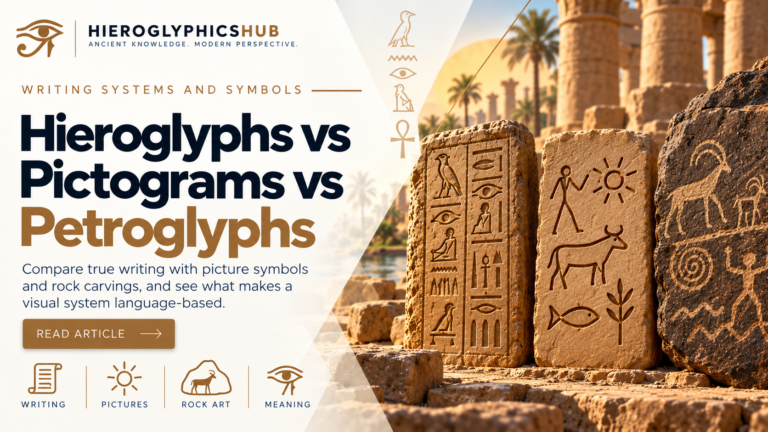
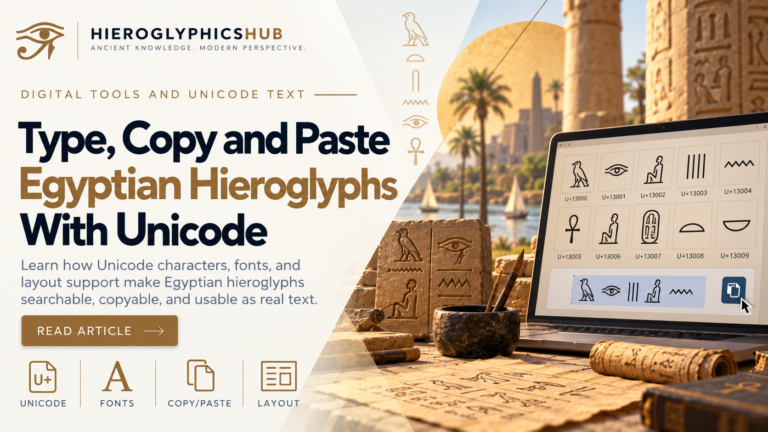
Unicode’s current Egyptian Hieroglyph Database uses the term classifier, while noting that such signs are traditionally called determinatives. It defines a classifier as a sign indicating the semantic category of a word and describes it as mute in that function.
This is an important correction to the beginner habit of assuming:
one visible sign = one sound
That assumption already breaks down with biliteral and triliteral hieroglyphs, where a single sign can represent two or three consonants.
Determinatives break it in the opposite direction.
A sign can be visibly present while adding no further consonant at all.
“Determinative” and “Classifier” Do Not Mean Exactly the Same Thing
The traditional term determinative is still widely used and remains useful.
But it can suggest that the final sign uniquely determines one precise dictionary definition. That is often too strong.
Classifier emphasizes what the sign actually does: it places the written word in a broader conceptual category.
A walking-legs sign, for example, may be associated with words involving movement. It does not translate every such word as “walking.” A human figure can mark a word associated with a person without becoming the word “man.” A settlement sign can identify a place-name without contributing the name of the settlement itself.
The distinction is more than terminology.
Thinking in terms of classification prevents a common reading mistake: translating the determinative as though it were an extra word.
Modern Unicode terminology reflects this semantic role directly, while retaining “determinative” as the familiar traditional name.
For practical reading, both terms are worth knowing. In this article, determinative refers to the traditional category, while classifier helps explain what that category actually does.
Anubis Provides a Clear Example
UCL’s introductory reading exercise uses the Egyptian name of Anubis to demonstrate the system particularly well.
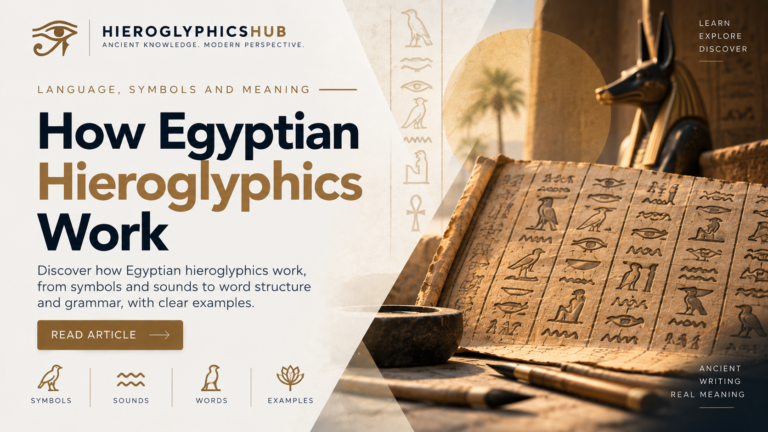
The name is written with phonetic signs supplying the consonants conventionally transliterated ꞽnp, followed by a sign depicting the god in jackal form.
The final sign does not add another sound to ꞽnp.
Instead, it tells the reader what kind of entity the phonetic spelling refers to. In this context, the image identifies the word with the god Anubis.
That small word shows two information systems operating together:
phonetic signs: tell the reader how the word is written linguistically
determinative: tells the reader something about what kind of thing the word denotes
Neither system makes the other unnecessary.
This is one reason Egyptian writing cannot be reduced either to an alphabet or to a collection of symbolic pictures.
Determinatives Can Separate Words That Look Similar Phonetically
Their usefulness becomes clearer when two words have comparable consonantal spellings.
If the phonetic part alone does not immediately distinguish the intended meaning, the final classifier can push the reader toward the correct semantic field.
A Cambridge introduction to Middle Egyptian illustrates this principle with words whose phonographic spellings are differentiated by the signs added at the end. One receives a classifier associated with seeds; another uses walking legs for a concept involving emergence or movement. The determinatives provide information that the phonetic sequence alone does not.
This does not mean Egyptians were unable to understand their own language without such signs.
Context, grammar, vocabulary, and conventional spelling all matter.
The classifier supplies an additional layer of written information.
That layer is particularly valuable in a script where vowels were not normally represented in the same manner as consonants.
What Kinds of Meaning Can Determinatives Classify?
There is no tiny fixed list of categories.
Egyptian scribes could draw on signs covering many areas of experience. UCL’s determinative reference includes examples connected with:

| Semantic area | What a determinative may signal |
|---|---|
| People | A word concerning a human being or human role |
| Houses and buildings | A structure or building-related concept |
| Towns and settlements | A place or settlement |
| Desert and foreign land | Geographic or foreign-land associations |
| Funerary matters | Death, burial, or funerary contexts |
| Food | Bread, cakes, foodstuffs, and related vocabulary |
| Beer | Beer or related food/drink vocabulary |
| Time/day | Concepts connected with the sun or day |
UCL presents these explicitly as examples rather than a complete inventory.
More detailed sign classifications extend much further.
Human figures can distinguish different kinds of human actions or states. Movement can be marked differently from speech. Plants, documents, divine beings, harmful concepts, body-related terms, and many other semantic domains can receive recognizable classifiers.
The result is not a rigid taxonomy comparable to a modern database.
It is a writing system in which visual categories help organize meaning.
The Picture Gives a Category, Not Necessarily a Literal Translation
A determinative depicting legs provides a useful test.
If walking legs appear at the end of a word, translating them literally as “legs” or “walking” may distort the word.
Their job may instead be to identify the preceding word as belonging to a semantic field involving movement.
The same principle applies to many human classifiers.
A seated person after an Egyptian word does not automatically mean the expression should be translated with “man” at the end. The person sign can tell the reader that the preceding phonetic group denotes a human being.
Compare:
phonogram: contributes sounds
logogram: can represent a word
determinative/classifier: contributes semantic classification without normally contributing another pronounced element
A single hieroglyphic form may be capable of more than one function in different settings. That is why the context-first approach explained in our guide to hieroglyphic symbols and meanings matters so much.
Identifying the picture is only the beginning.
Where Does the Determinative Appear?
In the common pattern, determinatives occur toward the end of the written word, after its phonetic components.
That position is extremely useful when learning to segment hieroglyphic text.
A reader who encounters a sequence of sound signs followed by a recognizable semantic classifier has a clue that the word may be ending there.
Unicode’s current definition similarly describes the classifier as a sign written at the end of words to identify their semantic category.
This should not be turned into an inflexible visual rule.
Egyptian orthography developed across a very long history. Scribal practices varied, spellings were not mechanically uniform, and hieroglyphic groups were also arranged with visual considerations in mind.
Still, recognizing likely determinatives is one of the practical tools that helps a learner move from identifying individual signs to seeing word groups.
That is a major step in learning to read an inscription.
A Determinative Can Help You Find a Word Boundary
Hieroglyphic texts generally do not separate every word with spaces in the way modern English does.
For a beginner, this can make a line of signs appear continuous.
Determinatives provide clues.
Suppose you identify several phonetic signs and then encounter a classifier associated with people. The classifier may indicate both:
- something about the meaning of the preceding word, and
- that the written group has reached a likely boundary.
The next sign may begin another word.
This does not remove the need to understand grammar or vocabulary, but it narrows the possibilities.
That makes determinatives useful at two levels simultaneously:
semantically, they classify meaning;
graphically, they can help expose the structure of the written text.
Readers who know the basic process for reading Egyptian hieroglyphics can therefore use classifiers as part of word recognition rather than treating them as decorative additions.
Not Every Determinative Is a Picture of the Exact Thing Named
Some cases are very direct.
A word for a particular object may be followed by an image closely related to that object.
Other determinatives are broader.
A general person sign may classify many different kinds of people. Walking legs may appear with words involving motion rather than only words meaning “walk.” A papyrus-roll or document-related sign can classify abstract or written concepts rather than depicting the literal referent of every word it follows.
That difference reveals why classifier is such a useful term.
The sign does not have to illustrate the precise dictionary entry.
It identifies a conceptual neighborhood.
This is also where memorizing lists such as “symbol X means Y” begins to fail. Egyptian writing often depends on relationships among signs rather than isolated definitions.
More Than One Classifier Can Be Relevant to a Word
Semantic classification does not always have to be one-dimensional.
A concept can belong to more than one meaningful category, and Egyptian spellings can show variation in the signs used to classify related words or uses.
Modern research has drawn attention to the fact that determinative choice can contribute semantic nuance rather than merely repeating a fixed dictionary category. UCL has specifically highlighted scholarly interest in the way different determinatives may create or emphasize additional connotations according to textual context.
That observation changes how we should approach spelling variation.
If two occurrences of a word use different classifiers, the safest conclusion is not immediately that one scribe made a mistake.
Questions worth asking include:
- Is the word being used in a different sense?
- Does the classifier emphasize a particular aspect of the concept?
- Is the spelling from another period or textual tradition?
- Is the script hieroglyphic or cursive?
- Is one classifier more specific while another is more general?
The semantic sign can itself become evidence.
Determinatives Were Not Equally Specific in Every Script
Egyptian was written in more than monumental hieroglyphs.
Hieratic and later Demotic developed as cursive writing systems, and the way classifiers were represented could differ from monumental hieroglyphic practice.
Recent scholarship discussing Egyptian visual writing notes that hieroglyphic spelling can favor highly specific pictorial signs where cursive scripts may use more generic classifiers.
One example discussed by Cambridge concerns the Egyptian word for a headrest. A hieroglyphic spelling could employ a pictorial headrest as a highly specific classifier, while hieratic uses could favor a more general sign associated with wood or wooden objects.
That comparison shows something deeper than a change in handwriting.
Semantic classification can operate at different levels of specificity:
headrest → wooden object → object
The written choice tells us how precisely the scribe chose to categorize the word.
Do Determinatives Ever Have a Sound?
A sign used as a determinative is normally silent.
But the same hieroglyphic shape may have a phonetic function elsewhere.
This is one of the recurring principles of the Egyptian script: the identity of a sign does not permanently determine its function.
Unicode’s Unikemet database allows hieroglyphs to carry multiple documented function types because a sign may operate differently according to context.
Therefore:
“This sign can be a determinative”
does not mean:
“This sign never has a phonetic value.”
The proper question is:
“What is this sign doing in this occurrence?”
Position, surrounding phonograms, known spellings, grammar, and meaning all help answer it.
Why Determinatives Usually Disappear in English Translation
A translated Egyptian sentence may contain information that has no visible counterpart in the English wording.
That is normal.
If a silent human classifier follows an Egyptian word meaning a person, an English translator generally does not add “person” as an extra word merely to represent the hieroglyph.
The classifier has already done its job inside the Egyptian writing system.
This creates an important difference between transcription, transliteration, and translation.
A hieroglyphic transcription preserves the written signs.
A transliteration represents linguistic elements using scholarly characters and conventions.
A translation expresses the resulting meaning in another language.
Semantic classifiers do not move through all three stages in the same way that pronounced consonants do.
This is one reason a raw sign-by-sign conversion can preserve visible hieroglyphs while still misunderstanding the text.
Determinatives Matter to Digital Translation Too
A useful hieroglyphic translation system should not assume that every sign supplies another piece of pronunciation.
If it treats a person classifier as a sound, or translates walking legs literally whenever they appear, the interpretation can quickly become distorted.
The opposite mistake is also possible: deleting every apparently silent sign before examining what semantic information it carries.
The better approach is to preserve the distinction between phonetic content and classification.
That principle is relevant to the HieroglyphicsHub translator because Egyptian-to-English interpretation requires more than replacing glyphs with dictionary labels. A classifier can help narrow the intended word even though it contributes nothing that should be pronounced aloud.
In other words, silence does not mean irrelevance.
For some words, the silent sign is precisely what helps the reader understand what the pronounced signs are supposed to mean.
How to Use Determinatives When Reading an Unknown Word
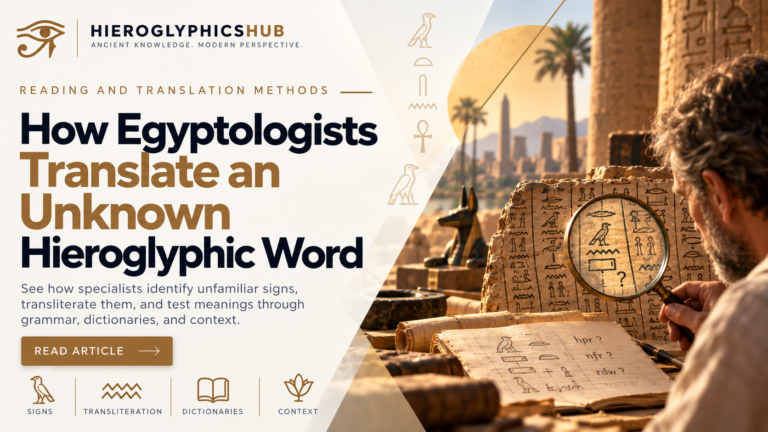
When an unfamiliar group appears in an inscription, do not begin by trying to translate every picture.
A more reliable sequence is:
1. Separate likely phonetic material from semantic signs
Identify the signs whose sound values you recognize.
Do not assume every remaining sign must supply an additional consonant.
2. Look toward the end of the group
Ask whether a final sign resembles a familiar classifier: person, place, movement, building, divine being, food, document, body part, or another semantic category.
3. Use the classifier to narrow the possibilities
If the phonetic spelling could correspond to more than one word, the classifier may indicate which semantic field is plausible.
4. Check grammar and surrounding context
A determinative is evidence, not a complete translation.
The sentence still has to make grammatical and semantic sense.
5. Check established spellings
Egyptian dictionaries, sign lists, and reliable text editions can confirm whether the word is attested with that classifier or with related ones.
This workflow is much safer than assigning an English meaning to every individual picture before considering the word as a whole.
What a Determinative Cannot Tell You
Determinatives are powerful reading clues, but they have limits.
A person classifier does not tell you the person’s exact identity.
A settlement classifier does not by itself tell you which town is meant.
Walking legs indicate a relationship with movement or an associated semantic field, but they do not independently provide the verb’s tense, subject, or full lexical meaning.
A divine classifier helps signal that a name or expression concerns a deity, but it does not replace knowledge of the name itself.
And classifiers do not eliminate ambiguity from Egyptian texts.
Interpretation still depends on vocabulary, grammar, chronology, spelling conventions, inscription type, and surrounding context.
Treating determinatives as perfect semantic labels would simply replace one oversimplification with another.
The Silent Sign Is Often the Sign Worth Looking At Twice
When beginners first encounter hieroglyphs, the signs that produce recognizable consonants usually receive most of the attention.
Determinatives seem less important because they are not pronounced.
For actual interpretation, that hierarchy can be backwards.
A silent sign can tell you that a consonantal sequence denotes a person rather than an object, movement rather than a physical thing, a settlement rather than an ordinary noun, or a divine being rather than another word with a similar spelling.
It can indicate where a word ends.
It can expose how Egyptians categorized a concept.
And when classifier choice varies, it can sometimes preserve semantic information that disappears entirely from an English translation.
The phonetic signs tell you what to read.
The determinative can help tell you what kind of thing you have just read.
That partnership between sound and classification is one of the mechanisms that makes hieroglyphic Egyptian a functioning writing system rather than a collection of pictures.