Hieroglyphic Symbols and Meanings: What Common Egyptian Signs Actually Do
An owl appears in an Egyptian inscription.
What does it mean?
If hieroglyphs were a collection of picture symbols, the answer might be “owl.” In many Egyptian words, however, the owl sign contributes the consonantal value m. The bird in the picture and the job performed by the sign are not necessarily the same thing.
That small example exposes one of the biggest problems with lists of “Egyptian symbols and meanings.” They often present each hieroglyph as though it had one permanent English definition.
Egyptian writing does not work that way.
A hieroglyph can represent a sound, stand for an Egyptian word, help identify the type of word being written, or function pictorially. Some signs can perform more than one of these jobs depending on the context. Unicode’s current Egyptian Hieroglyph Database therefore records sign functions rather than assigning every character a single universal meaning. Its categories include phonograms, logograms, classifiers traditionally called determinatives, pictograms, and several more specialized functions.
Understanding those functions is far more useful than memorizing a long list of pictures with English labels.
A Hieroglyph Has a Form, a Value, and a Function
Three separate questions help make sense of almost any Egyptian sign:
What does the sign depict?
This is its visual form. A hieroglyph may show a mouth, bird, hand, house, sun, plant, animal, tool, or human figure.
What linguistic value can it carry?
Some signs represent one or more consonants. Others can represent complete Egyptian words.
What is it doing in this particular word or inscription?
This is the part that a simple symbol dictionary often misses.
Consider the mouth sign 𓂋. Visually, it depicts a mouth. In phonetic use it can represent r. But the fact that it looks like a mouth does not mean every occurrence should be translated as “mouth.”
The same principle applies throughout hieroglyphic writing.
If you are already familiar with the individual consonantal signs, our guide to the Egyptian hieroglyphic alphabet explains how those uniliteral sound values work. Here, the more important question is what happens when signs are used in different ways.
The Four Functions Beginners Need to Recognize
Egyptological terminology can become detailed, but four broad functions explain much of what a beginner encounters.
Phonograms represent sounds
A phonogram contributes consonantal information.
Some phonograms represent one consonant. Others represent two or three. The picture itself does not have to describe the word being written.
The familiar water-ripple sign 𓈖, for example, can represent n. The owl 𓅓 can represent m.
In those uses, the writer is choosing the sign because of its sound value.
UCL’s description of the Egyptian writing system separates phonetic signs according to whether they represent one, two, or three consonants, confirming that Egyptian spelling used much more than one-picture-one-word correspondence.
Logograms represent words
A logogram represents a word rather than merely one component of its spelling.
This is where the picture can sometimes appear strikingly direct.
The floor-plan-like house sign can write pr, “house.” The sun disk can represent rꜥ, “sun,” and is also associated with the name of the solar god Ra/Re. UCL’s collection of Egyptian ideograms includes examples such as pr for house, rꜥ for sun, nwt for town, and signs for words including beer and coffin.
A sign functioning as a word sign has both linguistic value and meaning. That is different from a phonogram whose job is primarily phonetic.
Determinatives classify meaning without adding another spoken sound
Egyptian often writes consonantal information and then adds a sign that helps the reader understand what kind of word has just been written.
Traditionally, Egyptologists call such signs determinatives. “Classifier” is also used.
A human figure may indicate that a word concerns a person. A settlement sign can classify a place. Other determinatives can identify semantic areas connected with buildings, movement, food, desert regions, funerary matters, actions, and many other concepts.
These signs are especially valuable because consonantal spellings can otherwise be ambiguous.
UCL lists determinatives for categories including houses and buildings, people, towns and settlements, desert or foreign land, funerary contexts, food, and beer.
The classifier normally contributes meaning without simply becoming another pronounced consonant at the end of the word.
Pictorial and symbolic uses can operate outside ordinary spelling
Hieroglyphic signs were not confined to sentences.
A recognizable hieroglyph could be used decoratively, symbolically, ritually, or as part of an object whose physical form carried the sign’s significance.
This is one reason an ankh on an amulet cannot always be approached in exactly the same way as an ankh embedded in a written phrase.
The distinction matters: a sign can belong to the writing system and also become a powerful visual symbol in Egyptian material culture.
Common Hieroglyphic Signs at a Glance
The table below is best read as a guide to possible functions, not a promise that each sign always means the English word shown.
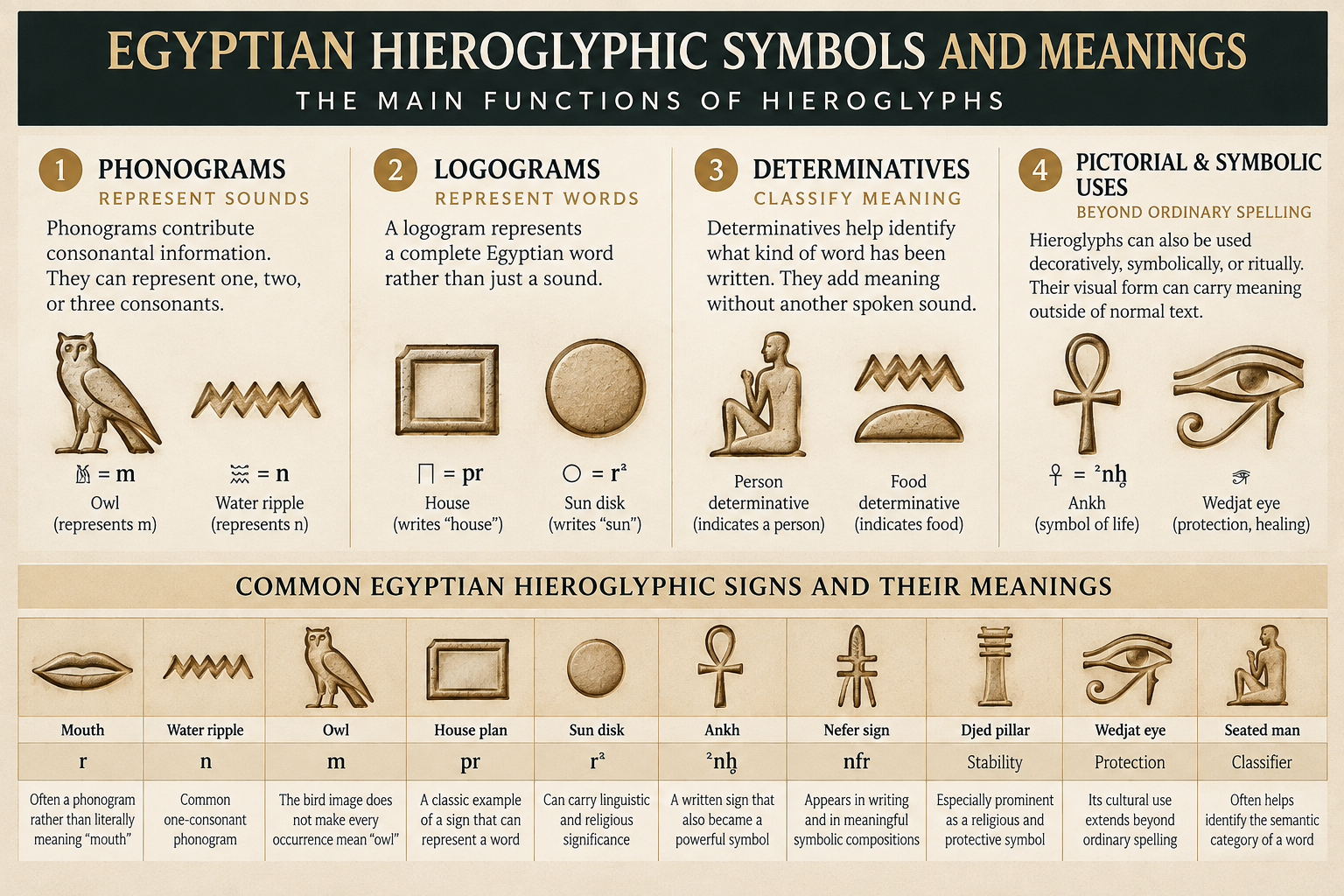
| Sign | Common identification | Important value or association | What to remember |
|---|---|---|---|
| 𓂋 | Mouth | r; also connected with the word for mouth | Frequently functions phonetically rather than literally meaning “mouth” |
| 𓈖 | Water ripple | n | Common one-consonant phonogram |
| 𓅓 | Owl | m | The bird image does not make every occurrence mean “owl” |
| 𓉐 | House plan | pr, house | A classic example of a sign that can represent a word |
| 𓇳 | Sun disk | rꜥ, sun/Ra | Can carry linguistic and religious significance depending on context |
| 𓋹 | Ankh | ꜥnḫ, life/live | A written sign that also became a powerful symbol of life |
| 𓄤 | Nefer sign | nfr, good/beautiful/perfect | Appears in writing and in meaningful symbolic compositions |
| 𓊽 | Djed pillar | Stability/endurance | Especially prominent as a religious and protective symbol |
| 𓂀 | Wedjat eye | Wholeness, restoration, protection | Its cultural use extends beyond ordinary word spelling |
| 𓀀 | Seated man/person | Human-related classification in many contexts | Often helps identify the semantic category of a word |
The important column is the last one. Egyptian hieroglyphs make more sense once you stop asking only “What does this picture mean?” and begin asking “Why was this sign placed here?”
The Ankh Shows Why “Meaning” Can Be More Than Translation
Few Egyptian signs are as recognizable as 𓋹, the ankh.
It is commonly described as the symbol of life, and that description is justified. The Met notes that the ankh was used as a hieroglyph in writing words meaning “live,” “alive,” or “life.” It also became a broader symbol of life and appears frequently in religious imagery.
Those two facts should not be collapsed into one.
In a written text, the ankh can participate linguistically.
In a temple scene, a deity may present an ankh to a king in a way that visually expresses the giving of life.
As an amulet or ceremonial object, the sign’s shape itself can carry significance.
An Early Dynastic libation dish in the Met collection was even formed around hieroglyphic elements including the ankh and the ka sign. The museum explains that the ankh reads “life” or “to live,” while the combined design gives the object a deeper ritual significance.
So “ankh = life” is useful, but it is only the beginning of the explanation.
The Djed Is Not Just a Decorative Pillar
The djed 𓊽 is conventionally associated with stability or endurance.
It appears in Egyptian religious symbolism and was used extensively as a protective motif. The sign can occur alongside other positive signs, particularly the ankh and the was scepter.
A Late Period–Ptolemaic object in the Met combines ankh, djed, and was signs representing life, stability, and dominion in a deliberately meaningful composition.
This tells us something important about hieroglyphic symbols outside continuous text.
Egyptians could select signs because their meanings were desirable in their own right. A group of hieroglyphs on an amulet might therefore communicate protective or auspicious concepts without behaving like an ordinary sentence.
The Met documents Middle Kingdom scarabs where signs were arranged for positive or protective meaning rather than to form normal words.
That is a different use of the writing system, and it is easily missed when every inscription is treated as if it must translate into a grammatical English sentence.
Nefer Can Function as Language and as a Positive Sign
The nefer sign 𓄤 is another useful example because it crosses the boundary between written language and symbolic composition.
The Egyptian word nfr can carry meanings associated with goodness, beauty, perfection, or favorable quality depending on context. In inscriptions, the sign participates in writing that word and related forms.
But nefer also appears prominently on scarabs and other objects where its favorable meaning contributes to the purpose of the composition.
One Middle Kingdom scarab documented by the Met combines nefer with an ankh and a basket sign. The signs were chosen for their positive significance rather than simply forming a normal written statement.
This is why translating an isolated hieroglyph can be harder than translating a word in context.
The reader needs to know whether the sign is:
- writing a word,
- contributing a sound,
- forming part of a symbolic design,
- or participating in another conventional use.
The picture alone cannot settle the question.
The Wedjat Eye Is a Hieroglyph, an Image, and an Amulet Form
The wedjat eye, commonly called the Eye of Horus, illustrates another category of complexity.
Its Egyptian meaning is tied to restoration and wholeness through the mythological restoration of Horus’s injured eye. Wedjat-eye amulets became extremely common protective objects.
The Met describes the wedjat as the healed eye of Horus and explains its associations with healing, regeneration, rebirth, and protection.
Calling it simply “the symbol for protection” loses important information.
It has a name. It has a mythological context. It can appear as a hieroglyphic form. It can also exist as a three-dimensional amulet whose purpose depends on Egyptian religious practice.
The difference between what a hieroglyph can write and what its image can symbolize is therefore essential.
A Person at the End of a Word May Not Be Part of Its Pronunciation
Some of the most informative signs are much less famous than the ankh or Eye of Horus.
Suppose a word ends with a human figure.
A beginner might assume the figure must represent another sound or that the word literally contains “man.” But a human sign can instead be functioning as a classifier, telling the reader that the preceding word concerns a person or human activity.
Unicode’s Egyptian sign annotations give a clear sense of how specific such classifications can become. For example, its current names list identifies one seated-person sign as a general classifier for a human being, while other human signs classify activities or concepts involving eating, drinking, speaking, silence, thoughts, feelings, supplication, hiding, and related actions.
These signs reveal something that an English translation may completely hide.
Two Egyptian words might have similar consonantal spellings, yet their classifiers point the reader toward different semantic categories.
That is one reason determinatives are not disposable decoration. They are part of how written Egyptian communicates meaning.
One Sign Can Change Jobs
The most important rule in this entire article is simple:
Do not permanently assign a hieroglyph to one function.
Unicode’s current hieroglyph database explicitly notes that a single hieroglyph may have multiple function types. The documentation is still being refined, but the underlying principle is clear: a sign’s documented use cannot always be reduced to one fixed category.
Imagine an English reader encountering the picture of a house.
Depending on context, an Egyptian sign depicting a house might be associated directly with the word pr, “house,” while building-related signs can also participate in semantic classification.
The correct interpretation comes from the surrounding signs, the spelling, the grammar, and the type of inscription.
This is why our broader explanation of how Egyptian hieroglyphics work treats hieroglyphs as a functioning writing system rather than a code in which every image can be swapped for one English word.
Why Online “100 Egyptian Symbols and Meanings” Lists Often Go Wrong
Large symbol lists are attractive because they look easy to use. Their limitations become obvious once you try to interpret an actual inscription.
A typical list may say:
Owl = wisdom
Eye = protection
Sun = Ra
Ankh = life
Only one of those labels may describe the relevant function in a particular piece of writing.
The owl is especially instructive. Modern cultural associations may connect owls with wisdom, but that is not a reliable rule for reading an Egyptian inscription. In Egyptian phonetic writing, the owl is well known for its m value.
The sun disk can represent the sun and can participate in writing the name of Ra, but its interpretation still depends on its surroundings.
The Eye of Horus has strong protective associations, yet identifying those associations does not mean every eye-shaped hieroglyph everywhere can simply be translated as “protection.”
Reliable interpretation therefore requires more than visual recognition.
A symbol list becomes genuinely useful only when it tells you:
- what the sign depicts,
- its known phonetic or lexical values,
- the roles it can perform,
- whether a stated “meaning” is linguistic, religious, or symbolic,
- and how context changes interpretation.
Without those distinctions, the list may teach icon recognition without teaching Egyptian writing.
Symbols Can Form Meaningful Compositions Without Forming Sentences
One of the more interesting features of Egyptian material culture is that hieroglyphic signs could be assembled into compositions whose effect was semantic and symbolic rather than ordinary grammatical prose.
Middle Kingdom scarabs provide good evidence.
The Met records objects where signs such as the ankh, djed, nefer, royal symbols, and wedjat eyes appear in symmetrical arrangements selected for favorable or protective associations. In some examples, the museum specifically notes that the signs are not intended to form words.
This prevents another common mistake: assuming that every row of Egyptian-looking signs must contain a sentence waiting for word-by-word translation.
Sometimes the meaningful question is not:
“What sentence does this say?”
It is:
“What ideas did these signs bring together, and what was this object meant to accomplish?”
The physical object, archaeological context, arrangement, and period can all matter.
Context Decides More Than Appearance
If you encounter an unfamiliar Egyptian sign, resist the temptation to identify the picture and stop there.
Instead, work outward from the sign.
Look at the signs beside it. Determine the reading direction. Ask whether recognizable signs are providing sounds. Check whether a final image behaves like a classifier. Consider whether the text is a name, title, offering formula, religious statement, label, monumental inscription, or decorative composition.
Then ask whether the object itself changes the interpretation.
An ankh carved within a written phrase, an ankh held toward a king’s face in a temple scene, and an ankh-shaped amulet are related through the idea of life, but they are not identical acts of communication.
This context-first approach is also why a hieroglyphics translator should not be understood as a simple symbol-substitution machine. Translating Egyptian requires recognizing linguistic relationships and sign functions, not merely matching pictures to English labels.
What “Meaning” Should Mean When You Study a Hieroglyph
When researching a particular symbol, try to record its information in layers.
For example:
Sign: 𓋹
Visual identity: ankh
Egyptian linguistic association: ꜥnḫ, relating to life/living
Possible written role: participates in writing words connected with life
Broader symbolic role: life, especially in religious and ritual settings
Material use: also appears as amulets and ceremonial forms
That is much more informative than:
𓋹 = life
The short definition is not necessarily wrong. It is simply incomplete.
The same method works for less famous signs. A useful hieroglyphic reference should distinguish the picture, the sound value, the word value, the grammatical or semantic function, and any broader cultural symbolism when those categories apply.
Once those layers are separated, apparent contradictions often disappear.
A bird can be a bird in an image and a consonant in a word.
A house can be a pictured building and a written word.
A human figure can classify a word without being pronounced.
A sign for life can also become an amulet shaped around the concept it expresses.
That flexibility is not an exception to Egyptian hieroglyphic writing.
It is part of the system itself.


2 Comments