Hieroglyphic Quadrats: How Egyptian Signs Are Grouped and Read
Egyptian hieroglyphs are not normally arranged like letters on a modern keyboard line.
A short sign may sit above another. Two narrow signs may share a block side by side. A small sign can be tucked into available space beside a larger one. Several signs belonging to one word may extend across more than one block, while a single block can even contain a word boundary.
Egyptologists often describe these balanced sign groups as quadrats.
The term is useful, but it can create the wrong mental picture if taken too literally. A quadrat is not necessarily a perfect square, and it is not a linguistic unit such as a word, syllable, or sound. It is primarily a graphic grouping unit: a way of arranging hieroglyphs so that an inscription is compact, legible, and visually balanced.
Understanding quadrats means learning to separate two things that Egyptian writing combines elegantly:
where signs are placed
and
the order in which the language is read
A Quadrat Is a Layout Unit, Not a Word
This is the distinction everything else depends on.
A quadrat tells you that signs have been composed together visually. It does not automatically tell you where an Egyptian word starts or finishes.
One quadrat may contain a single sign. A longer word may continue across several quadrats. Several signs belonging to one word can share a block, and a word boundary can occur inside one.
That is very different from modern English, where spaces normally mark word boundaries and letters proceed along a line in a single dimension.
Egyptian monumental writing does not depend on spaces between every word. Readers identify words through spelling, classifiers, morphology, grammar, familiar expressions, and context.
A quadrat therefore answers:
How are these signs arranged on the writing surface?
It does not by itself answer:
Which signs make up the word?
Confusing those questions can produce a perfectly neat but linguistically incorrect segmentation.
Why Signs Were Packed Into Blocks
Hieroglyphs vary dramatically in shape.
Some are tall and narrow. Others are broad and low. Birds, seated figures, water ripples, loaves, arms, buildings, reeds, and vessels do not naturally occupy equal amounts of space.
If every sign were placed at identical height in a flat row, inscriptions would develop large gaps and awkward concentrations of empty space.
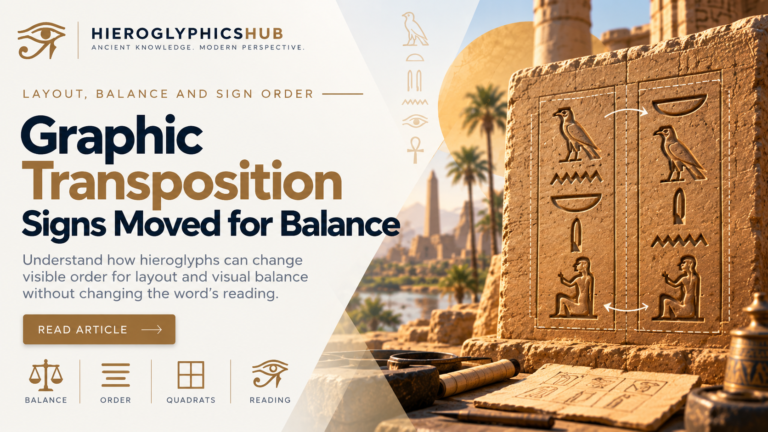
Egyptian scribes and monument designers instead adjusted size and placement so that signs formed balanced groups. A tall sign might occupy one side while two shorter signs were stacked beside it. Two compact signs could sit next to each other. A wide low sign could appear beneath another. Small signs could be inserted into usable space around a larger form.
The principle is better understood as a notional rectangular area than as a rigid square grid. Some quadrats are nearly square; others are taller, wider, or adapted to the available line or column.
There is also no requirement that every visible space be filled. A single sign can occupy a group on its own if that composition works.
The aim is balance, not geometric uniformity.
The basic arrangements
Most beginner examples use a small set of visual relationships:
- single sign — one sign occupies the group;
- horizontal grouping — signs sit beside one another;
- vertical grouping — one sign sits above another;
- mixed grouping — a tall sign shares space with a vertical pair or another compact group;
- insertion — a smaller sign occupies available space within or around the visual area of another sign.
These arrangements affect presentation. They do not create new sounds merely because the signs have been resized or stacked.
Establish the Direction Before Reading the Block
You cannot read a quadrat reliably until you know the direction of the larger inscription.
Hieroglyphic text can run horizontally from either side or vertically in columns. Human and animal figures usually face toward the beginning of the text.
If people and birds face right, the reader normally starts on the right and moves left. If they face left, the reader normally starts on the left and moves right.
That principle is part of how to read Egyptian hieroglyphics, but quadrats introduce a second level: after finding the direction of the line or column, the reader has to resolve the signs inside each visual group.
A pair of signs placed side by side is therefore not automatically read “left sign first.” Its horizontal order follows the direction of that inscription.
The habit to avoid is simple:
do not import modern English left-to-right order into a text before checking which way the Egyptian writing faces.
How Standard Reading Order Works Inside a Quadrat
For an ordinary group without special transposition, the local reading rules are manageable.
Vertically grouped signs are read from top to bottom.
Horizontally grouped signs are followed in the reading direction of the text.
Imagine three signs whose logical sequence is:
A → B → C
If A is tall while B and C are small, the scribe may place A beside a vertical pair with B above C. The block is now two-dimensional, but the intended sequence can remain:
A → B → C
That is the crucial mental move.
Do not translate the geometry.
Reconstruct the sequence first.
A modern scholarly transcription can therefore present signs linearly even when an original monument stacks or nests them. The transcription is preserving sign order and linguistic analysis rather than reproducing every aspect of the ancient composition.
This is also why Gardiner's Sign List and quadrat reading solve different problems. A Gardiner reference tells you which sign is present. Quadrat analysis helps establish how several identified signs are spatially related and in what sequence they should normally be read.
A Quadrat Is Not a Syllable Block Either
The compact block can tempt readers to treat it as a single sound unit.
That is also incorrect.
A quadrat can contain a uniliteral, a biliteral or triliteral, phonetic complements, a classifier, parts of multiple words, or a mixture of these.
The block itself has no fixed pronunciation.
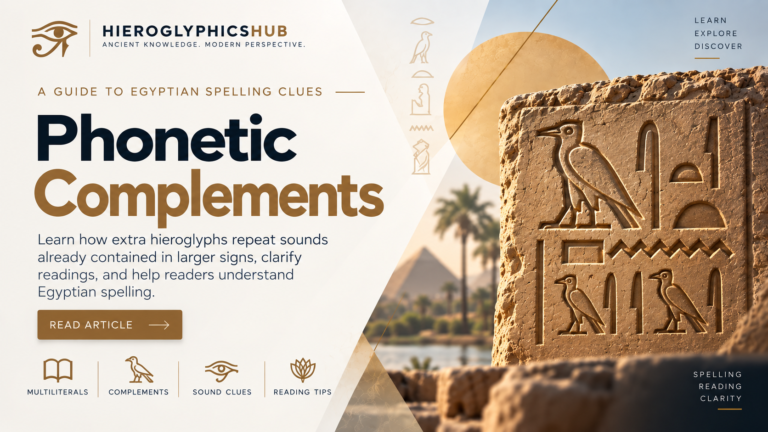
One large sign can carry more phonetic information than a crowded group of smaller signs. Conversely, several signs may repeat sounds already contained in another sign or contribute semantic classification rather than pronunciation.
Visual density and linguistic quantity are therefore not equivalent.
This matters particularly when a learner sees three signs packed together and assumes they must equal three successive sounds. Egyptian spelling does not work by counting visible pictures.
Quadrat Boundaries and Word Boundaries Are Different
A sequence of four neat blocks does not imply four Egyptian words.
A long spelling may cross from one quadrat into the next. A short grammatical word may share a block with material belonging to a neighboring word.
Word identification instead depends on evidence such as:
- known spellings;
- grammatical endings;
- articles and prepositions;
- attached pronouns;
- classifiers;
- sentence structure;
- formulaic expressions.
This is not a minor typographic detail. It affects lexical research directly.
As explained in how Egyptologists translate an unknown hieroglyphic word, dictionary work begins only after the reader has identified the likely lexical group. If quadrat boundaries are mistaken for word boundaries, the dictionary search may start from a sequence that was never a word in the first place.
Layout Can Vary Without Changing the Word
Hieroglyphic spelling has graphic flexibility.
The same underlying sequence can sometimes be arranged differently because the available space, shapes of the signs, line width, monument design, or scribal preference differ.
Two small signs may appear side by side in one inscription and stacked in another. A narrow sign can stand beside a compact pair. Signs may be reduced in scale to create a balanced group.
Egyptian orthography also permits genuine spelling variation. Phonetic complements may be present in one spelling and absent in another; classifiers and other elements can vary by period, genre, and scribal tradition.
These two kinds of variation should not be collapsed into one.
Changing the layout of the same signs is a graphic decision.
Changing which signs are written is an orthographic decision, even when visual balance helps influence the choice.
That distinction prevents a common oversimplification: Egyptian scribes cared about appearance, but the writing was not arbitrary decoration.
A classifier can share the block without becoming another sound
A determinative or classifier may sit beside or beneath phonetic material because the group has been composed visually.
Its position does not make it a new consonant.
The reader still has to distinguish what spells the word from what classifies its meaning.
Sharing a quadrat tells you about proximity on the surface, not equality of linguistic function.
When the Visual Order Is Not the Normal Linguistic Order
Ordinary groups can usually be handled with the direction and stacking rules above.
Real inscriptions also contain recognized exceptions.
Egyptian scribes could sometimes alter expected order for reasons of respect or composition. Divine and royal elements may be written earlier than they are read, and graphic considerations can occasionally affect sign order.
These phenomena should not become a general license to rearrange difficult text.
The safe method is:
- establish the normal direction;
- read ordinary horizontal and vertical groupings normally;
- test the resulting spelling and grammar;
- consider a recognized transposition only when the normal reading fails and there is positive linguistic or contextual evidence for the alternative.
The exceptional mechanisms deserve separate treatment because their causes are different from ordinary quadrat formation.
For this article, the important lesson is simply that visual order usually guides reading, but visual composition is not an infallible substitute for linguistic analysis.
How Unicode Represents Quadrats
Computers make the two-dimensional nature of Egyptian writing especially obvious.
A normal character string is linear. A hieroglyphic group may require signs to be placed above, beside, inside, or over one another.
Modern Unicode therefore includes dedicated Egyptian Hieroglyph Format Controls. The current Unicode documentation for Egyptian hieroglyphs defines controls for operations including vertical and horizontal joining, insertion, overlays, complex grouping, enclosures, and representation of damaged or missing areas.
For a basic vertical pair, the encoded sequence contains the first logical sign, a vertical-joining control, and the second sign. A supporting rendering system can display the first sign above the second while preserving the underlying logical sequence.
This exposes an important distinction:
character order stores the linguistic sequence; format controls describe how that sequence should be arranged visually.
The same principle applies to more complex blocks.
Earlier Egyptological digital systems used markup conventions such as the Manuel de Codage to describe spatial organization. Unicode now provides characters capable of representing many of those relationships directly, but the underlying problem is the same: a flat character stream has to describe a two-dimensional inscription.
Why Correct Unicode Signs Can Still Display Badly
Correct encoded characters do not guarantee a convincing quadrat on every device.
A font or layout engine may not fully support Egyptian formatting controls. Signs can appear in a flat row instead of a stack. Insertions can render incorrectly. Fallback fonts may use incompatible proportions, and complex groups can acquire poor spacing.
That is a rendering problem, not necessarily a linguistic one.
The distinction matters for the HieroglyphicsHub translator. Producing the correct Egyptian signs and reproducing monumental-style grouping are two separate technical tasks.
A system may generate the right sign sequence while displaying it poorly.
Conversely, an attractive block can still encode the wrong signs or wrong order.
Reliable digital hieroglyphics therefore require both:
correct character data
and
correct layout information
A Practical Method for Reading an Unfamiliar Quadrat
When a group looks crowded, work from the visual evidence toward the language rather than guessing the word immediately.
1. Find the direction
Use facing humans and animals and the wider layout of the inscription to establish where reading begins.
2. Identify the signs
Determine which characters are present. Gardiner references can help make the identification precise.
3. Map the grouping
Notice which signs are beside one another, which are stacked, and whether a smaller sign has been inserted into available space.
4. Reconstruct the normal sequence
Follow the reading direction horizontally and read standard vertical groups from top to bottom.
5. Ignore the temptation to make every quadrat one word
Test whether the spelling continues into the next block or whether a lexical boundary falls inside the current one.
6. Analyze what the signs are doing
Distinguish phonograms, phonetic complements, logograms, and classifiers.
7. Check the linguistic result
The reconstructed order should produce a plausible Egyptian spelling and grammatical sequence.
If it does not, revisit sign identification and grouping before invoking an exceptional reading order.
This method separates three questions that beginners often ask all at once:
What do I see? In what order should I read it? What does the resulting Egyptian mean?
The Three Assumptions to Drop
Most initial quadrat confusion comes from three modern habits.
“I always read the leftmost sign first.” Not until the direction of the inscription has been established.
“Each visual block must be one word.” Quadrats organize space, not vocabulary.
“The biggest sign in the block must come first.” Size reflects shape and composition, not automatic grammatical priority.
Once those assumptions are removed, the two-dimensional layout becomes much less mysterious.
Why Quadrats Matter
Quadrats show why Egyptian hieroglyphic writing cannot be understood as an alphabet printed with pictures.
The signs encode language, but they also have physical shapes that influence how text occupies a wall, stela, object, or manuscript.
A quadrat tells you how signs have been grouped visually.
The sign values tell you what linguistic material they contribute.
Grammar tells you how the resulting words relate.
Translation tells you how those relationships should be expressed in another language.
Keeping those levels separate is what turns a crowded block from a pictorial puzzle into readable writing.
Egyptian scribes were not choosing between language and design. Quadrat composition allowed them to use both at the same time.