How to Read an Ancient Egyptian Stela: Names, Titles, Offerings, and Layout
An Egyptian stela is not a page with a picture added underneath.
The image, inscriptions, names, titles, offerings, gestures, and spatial arrangement all work together.
That is why reading a stela sign by sign from the upper-left corner can fail before the translation even begins.
A better method starts with the monument as a whole.
First identify the type of stela and its broad date.
Then establish text direction.
Find the principal person or deity.
Separate names from titles and epithets.
Recognize repeated formulas.
Use the scene to clarify relationships without treating the image as a literal photograph.
Only then move into detailed transliteration and translation.
This approach is especially useful for private funerary and commemorative stelae, where a relatively small surface can combine several different kinds of information.
A Stela Is a Monument, Not One Fixed Text Type
The word stela describes a monument type rather than one literary genre.
Egyptian stelae could be:
- funerary;
- votive;
- commemorative;
- royal;
- temple-related;
- boundary markers;
- records of decrees or events.
Their layouts therefore vary enormously.
A Middle Kingdom private funerary stela can look very different from an Amarna boundary stela or a royal victory monument.
Even within one period, no single arrangement is compulsory.
For beginners, the safest habit is:
do not memorize one “standard stela layout” and force every object to match it.
Instead, learn recurring components and ask how they have been combined on the particular monument in front of you.
Read the Composition in Zones Before Reading Individual Signs
Before translating, look at the whole monument.
Ask:
- Is it round-topped or rectangular?
- Is there one scene or several?
- Where are the main text blocks?
- Are figures seated, standing, worshipping, or offering?
- Is an offering table prominent?
- Is one person or deity visually dominant?
- Are there horizontal registers or smaller subsidiary figures?
A useful first pass is to divide the surface into broad zones such as:
upper field
main inscription
principal scene
lower or subsidiary registers
Not every stela uses all four, and these zones are not modern paragraphs. They are parts of one visual-textual composition.
A large owner facing an offering table suggests a different reading environment from a king defeating enemies or worshipping a deity. Scene type helps predict what may appear in the text, but it never replaces the inscription.
Establish the Direction of the Hieroglyphs
Before translating, determine where each line begins.
Human and animal signs normally face toward the beginning of a hieroglyphic line.
If the signs face right, read toward them from the right.
If they face left, read from the left.
Vertical columns are generally read downward, but the order of columns still depends on orientation and composition.
A stela can also contain more than one local direction.
Text placed before one figure may face that figure.
Another caption elsewhere may be arranged differently.
So do not assume that the whole monument has one continuous reading path from top-left to bottom-right.
The principles in how to read Egyptian hieroglyphics still apply, but a stela adds the problem of coordinating several text blocks with several figures.
Identify the Main Person, Then Separate Names From Titles
Private stelae often organize the composition around one principal owner.
Useful clues include larger scale, a prominent position, repeated appearance, a substantial title sequence, or placement before the main offering table. But scale alone is not decisive. A deity can outrank the human owner visually, and a spouse may appear at comparable size.
The secure identification comes from combining image and inscription.
Once the principal person is located, separate the personal name from surrounding material.
A sequence may contain:
office → rank or epithet → personal name → funerary epithet
or another arrangement.
Words equivalent to “scribe,” “overseer,” or “priest” describe the person; they are not automatically part of the name. Likewise, mꜣꜥ-ḫrw, often translated “justified,” can follow a deceased person's name without belonging to the birth name itself.
The method in ancient Egyptian personal names is useful here: establish the name boundary first, then interpret the titles around it.
Titles can reveal office, temple role, administrative rank, specialization, or royal connection, but they should not be turned into a complete biography. Some are formulaic, and their significance can change over time.
Use Kinship Labels and Figure Placement Together
After identifying the owner, move outward to spouses, parents, children, colleagues, servants, or other participants.
A name beside a smaller figure may be introduced by a kinship label or title. Family names can repeat across generations, so the same name does not necessarily identify the same individual everywhere on the monument.
Ask:
Which text block belongs to which figure?
Is a kinship term actually written?
Is the person facing the owner, a deity, or the offerings?
Does the same person appear elsewhere?
Scale is useful but not literal. A smaller figure is not automatically a child; Egyptian art can use size to express hierarchy or status.
Images can therefore clarify probable relationships without supplying information that is not written. If a woman stands close to the owner and touches him, the scene may strongly support identification as a spouse. If her name is absent, however, the image does not create a missing name.
Offering Formula and Offering Scene Should Be Read Together—but Not Collapsed
On many private funerary stelae, the ḥtp-dỉ-nsw formula provides one of the strongest textual anchors.
Recognizing it can help identify the deity, offering vocabulary, beneficiary, and point at which a title-name sequence enters the inscription. The full structure is explained in the ḥtp-dỉ-nsw offering formula.
But a depicted offering table is not simply an illustrated word list.
Bread, meat, vegetables, birds, vessels, flowers, or other goods can reinforce the funerary provision expressed in writing without corresponding item for item to the formula.
The safest rule is:
the scene supplies visual and ritual context; the inscription supplies language.
Read them together, but do not turn every depicted object into a translated word or every written offering into a pictured object.
Appeals to the Living Change Who the Text Is Addressing
Some funerary stelae contain an appeal to the living.
This kind of text addresses people who encounter the monument rather than speaking only about the deceased.
The appeal may ask readers or passersby to recite an offering formula, praise the deceased, or perform another beneficial act.
That creates a shift in audience inside the same stela.
One section may invoke a deity.
Another may identify the owner.
Another can directly address future viewers.
Recognizing that shift prevents a common translation error: treating every line as though the same speaker were talking to the same addressee.
A stela can contain several voices and functions on one surface.
Register Order Is Not Always Sentence Order
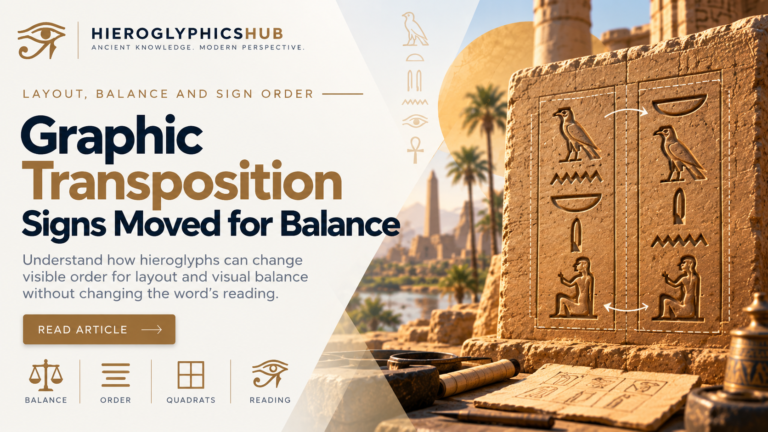
A line at the top can introduce material developed in a scene below. A caption beside one figure can belong only to that figure rather than to the nearest horizontal inscription. Several people in one register can have independent labels.
Reconstruct the monument block by block:
- identify a text block;
- establish its direction;
- determine which figure or scene it belongs to;
- read that block internally;
- connect it to the larger composition.
This is safer than flattening the whole stela into one continuous string.
The same principle applies at smaller scale in hieroglyphic quadrats: visual organization and linguistic order interact, but they are not identical.
Damage Can Change the Meaning of the Whole Monument
Stelae often survive chipped, eroded, broken, or reconstructed from fragments.
A missing corner can remove:
- the owner's name;
- a deity;
- a title;
- the first signs of a line;
- a kinship label.
That can make an apparently obvious interpretation uncertain.
If a name is damaged, do not restore it simply because the figure resembles someone known from another monument.
If only part of an offering formula survives, distinguish the signs that are actually present from the formula that is being reconstructed.
The evidence-chain method in how to check whether a hieroglyphic translation is reliable applies particularly well to damaged stelae.
Restoration should explain the surviving traces.
It should not replace them.
Worked Example: The Stela of Amennakht
The Metropolitan Museum of Art's Stela of Amennakht, a painted sandstone monument of Dynasty 12, shows how much can be learned before attempting a complete line-by-line translation.
Start with the shape and zones
The stela is round-topped.
The upper portion contains five lines of hieroglyphic inscription.
The much larger lower area is dominated by a scene.
That immediately suggests two major reading zones:
text above
ritual/funerary scene below
The museum identifies the upper text as containing both an offering formula and an appeal to the living, so even those five lines serve more than one textual function.
Find the owner
The principal male figure is Amennakht.
He stands at large scale with one foot forward, holding a long walking stick and a shorter staff.
His prominence, equipment, and the inscription together identify him as the stela's owner.
A woman stands beside him and touches his shoulder.
The museum identifies her as his wife but notes that her name is not recorded.
That is a useful lesson in evidence.
The relationship can be represented visually even when a personal name is absent.
Read the offerings as a system
In front of Amennakht is a pile of food offerings.
Vessels also appear lower in the scene, including a tall libation jar and three ovoid jars on a rack.
These objects reinforce the funerary provision expressed by the inscription above, but they should not be converted automatically into a word-for-word transcription of the formula.
Notice the smaller figures
At the far right are three smaller figures arranged on separate ground lines.
The museum cautiously describes the upper man and middle woman as perhaps the couple's son and daughter, while the lowest figure is probably a butler presenting a cup and bringing a bird.
Those words—perhaps and probably—matter. The figures are unnamed, so a careful reader preserves the museum's uncertainty instead of inventing a family genealogy.
Reconstruct the monument before translating it
The stela can now be summarized structurally:
upper inscription → offering formula + appeal to the living
main figures → Amennakht + unnamed wife
central provision → food + libation/drink vessels
subsidiary figures → probable family/household participants
That structural reading already tells us a great deal.
Only after this should the detailed hieroglyphic transcription be analyzed sign by sign.
A Practical Museum Reading Sequence
For an unfamiliar stela, use this order.
1. Date and context
Start with the museum's date and provenance. Conventions change across periods and places.
2. Monument type and zones
Decide whether the object is funerary, votive, royal, commemorative, or another type, then divide the surface into major text and image areas.
3. Direction
Establish the reading direction of each text block independently.
4. Principal participants
Identify the owner, deity, king, or main ritual figure.
5. Names and titles
Separate personal names from offices, epithets, and kinship labels.
6. Formulae and offerings
Recognize recurring structures without assuming every version is identical.
7. Secondary figures
Distinguish named relatives or officials from people whose identity is only inferred from the scene.
8. Damage
Mark what is missing or uncertain before restoring or translating it.
This order moves from secure visual evidence toward more interpretive linguistic analysis.
Common Shortcuts That Produce Bad Readings
Largest human figure = deceased. Not necessarily; a king, god, or other participant may dominate the composition.
Small figure = child. Scale can express status rather than age.
Every figure is named. Some people remain anonymous.
Every title belongs to the name. Titles and epithets must be separated grammatically.
The offering scene reproduces the offering list exactly. Text and image can reinforce one another without matching item for item.
Every text block reads in the same direction. Local captions can be oriented around different figures.
A damaged name can be restored because the scene “looks familiar.” Restoration requires textual and material evidence.
A stela is highly structured, but it is not mechanically standardized.
Read the Monument Before Reading the Sentence
A stela forces the reader to combine many parts of Egyptian epigraphy at once: direction, sign groups, names, titles, formulae, scene context, and damage.
That is why it is such a good translation exercise.
For the HieroglyphicsHub translator, a photograph of a stela is not merely a collection of hieroglyphs. A reliable system would first need to separate text regions, determine local directions, associate captions with figures, recognize repeated formulae, and preserve uncertainty before linguistic translation begins.
The same sequence works for a human reader:
identify the monument → map the layout → establish direction → locate participants → separate names and titles → recognize formulae → read the Egyptian → evaluate uncertainty
The most important habit is to begin with the stela rather than with one isolated sign.
The scene tells you where to look.
The inscriptions tell you what is said.
Names and titles identify participants.
Offerings establish ritual relationships.
Registers organize the monument.
Once those layers are separated and then recombined, the stela stops looking like a crowded slab of unrelated pictures and signs.
It becomes a structured Egyptian text.