How Many Egyptian Hieroglyphs Are There? Why the Numbers Differ
Ask how many Egyptian hieroglyphs there are and you can get answers ranging from a few dozen to many thousands.
That does not mean Egyptologists cannot count. It means the sources are often counting different things.
A chart of the basic one-consonant signs contains only about two dozen entries. A practical Middle Egyptian sign list contains several hundred. A broad pharaonic repertoire is larger again. Greco-Roman temple writing expands the inventory dramatically, while modern digital standards encode thousands of hieroglyphic characters across historical periods.
So the useful question is not simply:
How many hieroglyphs existed?
It is:
Which period, which repertoire, and what counts as a separate sign?
For much of the Old, Middle, and New Kingdoms, a useful scholarly scale is roughly 700–1,000 signs in regular use, alongside rarer forms. In Greco-Roman writing, modern scholars can distinguish around 10,000 variants.
Both figures can be correct because they describe different stages and different counting rules.
Why “24 Hieroglyphs” Is Not the Total
Some introductions begin with the so-called Egyptian alphabet, which can make the writing system look much smaller than it really is.
The Egyptian hieroglyphic alphabet is a subset: the uniliteral signs, which represent individual consonants in standard Egyptological analysis.
Egyptian writing also uses:
- biliteral signs representing two consonants;
- triliteral signs representing three consonants;
- logograms that can stand for whole words;
- classifiers or determinatives that help indicate meaning;
- additional specialized and less common signs.
So a count of the uniliterals answers:
How many basic one-consonant signs are there?
It does not answer:
How many hieroglyphic signs existed in the writing system?
That is the first major source of conflicting totals.
“Common Signs” and “Every Attested Sign” Are Different Things
A student reading Middle Egyptian does not need every form that appeared during more than three thousand years of hieroglyphic writing.
Practical sign lists therefore emphasize frequently encountered material.
Gardiner's famous catalogue is a good example. As explained in Gardiner's Sign List, Alan Gardiner organized the signs most useful for reading Middle Egyptian into a visual reference system. Modern summaries usually put the size of that inventory in the low 760s.
The exact low-760s total quoted by secondary sources can differ slightly according to which listed variants or additions they include, but that small discrepancy is not the important issue.
Gardiner's own purpose was selective. He was cataloguing common signs for study, not conducting a census of every hieroglyph ever carved, painted, or written.
That makes the list an excellent Middle Egyptian reference and an incomplete measure of the entire historical script.
The Repertoire Changed Over Time
Egyptian hieroglyphic writing remained in use for more than three millennia. A single permanent master inventory would therefore be historically misleading.
Signs entered use, became rare, acquired new functions, developed variants, or survived in specialized contexts.
The current Unicode Standard's overview of Egyptian hieroglyphs gives a useful scale for the pharaonic periods: throughout the Old, Middle, and New Kingdoms, between 700 and 1,000 hieroglyphs were in regular use, with many rarer signs beyond that core.
“Regular use” is the key phrase.
It does not mean the same exact inventory appeared at the same frequency in every dynasty, region, or genre. A Middle Kingdom funerary text and a New Kingdom temple inscription belong to the same writing tradition without using precisely the same repertoire.
Why Greco-Roman Counts Become So Large
The largest totals usually refer to much later temple writing.
During the Ptolemaic and Roman periods, hieroglyphic writing became especially elaborate in learned religious contexts. Priestly scribes exploited rare forms, graphic variants, unusual phonetic values, expanded logographic uses, and complex theological spellings.
As a result, the repertoire distinguished by modern scholars becomes much larger.
Unicode's current summary notes that the number of Greco-Roman variants, as distinguished by some scholars, grew to about 10,000.
That does not mean Middle Egyptian suddenly needed ten thousand basic symbols, nor does it mean an ordinary scribe in every period memorized ten thousand unrelated characters.
It describes a later, specialized expansion of the written repertoire.
What Counts as a Separate Sign?
This is where the counting problem becomes genuinely interesting.
Suppose two hieroglyphs depict the same basic object but differ in a small visual feature.
Are they:
one sign with two graphic variants
or
two distinct signs?
The answer depends on what the difference does.
A catalogue may separate forms when a distinction affects pronunciation, lexical function, iconographic identity, period, or established scholarly usage. Other visual differences may be treated as alternative glyphs of the same sign.
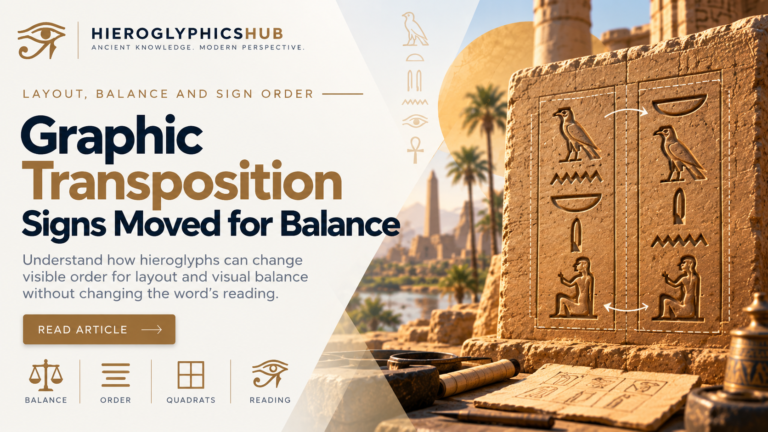
Orientation creates similar problems. A mirrored or rotated form may simply suit the layout of an inscription, while another modified form may acquire a specialized function.
Composite signs complicate matters further. What looks like one dense picture can sometimes be a conventional combination of elements rather than one elementary character.
There is therefore no useful total until the catalogue states its rules for splitting and merging forms.
Sign, glyph, variant, and character are not identical terms
A sign is an Egyptological unit recognized within the writing system.
A glyph is a particular visual rendering of a sign.
A variant is an alternative form related to another sign or glyph.
A character, especially in digital encoding, is an abstract unit represented independently by software.
These categories overlap, but they do not map perfectly onto one another.
One sign can have several glyphs. Two visibly different forms can be treated as variants of one underlying sign. A digital standard may encode distinctions separately because textual data needs to preserve them.
This is why “number of Unicode characters” and “number of signs an Egyptian scribe used” are not interchangeable statistics.
Multiple Meanings Do Not Create Multiple Hieroglyphs
Another misleading way to count would be to treat every function of a sign as a new sign.
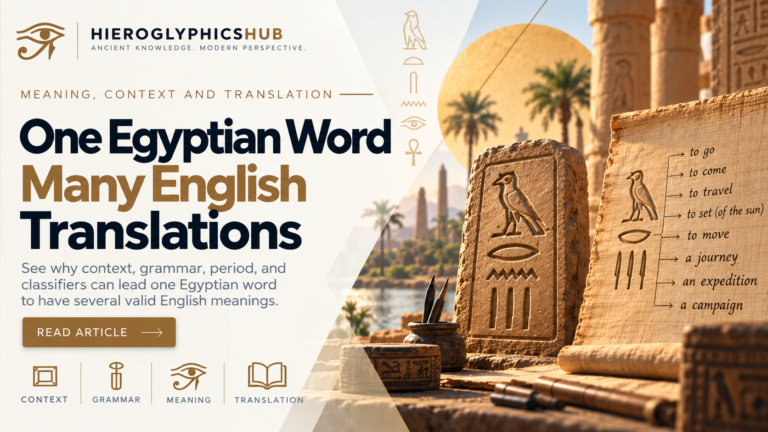
Egyptian hieroglyphs are multifunctional.
The same graphic sign can act as a phonogram in one spelling, a logogram in another, or a classifier elsewhere. Its linguistic role can change while its graphic identity remains the same.
The owl 𓅓, for example, does not become a new hieroglyph every time its function changes.
This distinction is central to hieroglyphic symbols and meanings: the object depicted, phonetic value, lexical meaning, and function in a particular word are related but not identical.
A sign database may therefore attach several readings or uses to one catalogued sign without increasing the sign count.
Visual Groups and Cursive Forms Can Inflate a Casual Count
Hieroglyphic writing is visually compact, which can make a group of several signs look like one complicated symbol.
As the guide to hieroglyphic quadrats explains, signs can be stacked, inserted, and arranged into balanced blocks.
A dense block is not automatically one new hieroglyph.
It may simply be several familiar signs composed together.
Hieratic creates a different trap. A cursive form can look very different from the corresponding formal hieroglyph, but that does not mean every historical handwriting form should be added to the monumental hieroglyph count as a new sign.
The distinction between hieroglyphs and hieratic is therefore important to counting as well as reading: related scripts can preserve corresponding linguistic material while using visually different forms and cataloguing traditions.
A total that mixes formal hieroglyphs, hieratic hands, sign groups, and variants without defining them will grow quickly but tell us very little.
Why Some Sources Say About 500
Another figure that appears in educational material is about 500 common signs.
That can be a reasonable estimate for a practical core used in introductory or Middle Egyptian teaching.
It should not be presented as the complete historical repertoire.
Frequency is uneven. Some hieroglyphs occur constantly; others are rare, specialized, regional, chronological, or genre-specific.
A learner can therefore read a substantial amount of Egyptian before mastering every sign in a larger catalogue.
“About 500 common signs” and “700–1,000 signs in regular use” are not necessarily contradictory if the sources define their practical core differently.
The problem comes when qualifiers such as common, regular, or Middle Egyptian disappear and the remaining number is presented as universal.
Why Unicode Now Contains More Than 5,000 Hieroglyphic Characters
Modern computing creates yet another kind of inventory.
Unicode needs to represent documented Egyptian text as data. The original Egyptian Hieroglyphs block covered a Gardiner-based repertoire with additional signs, and the later Egyptian Hieroglyphs Extended-A block greatly expanded coverage, especially for material important in later periods.
Across those two current hieroglyph blocks, more than five thousand Egyptian hieroglyphic characters are encoded.
That is a software repertoire, not a historical frequency list.
Unicode needs rare and specialized characters because researchers may need to encode texts from different periods. A character can therefore be essential to digital completeness even if it was uncommon historically.
Nor does Unicode attempt to give every artistic variation its own code point. Differences caused only by drawing style, carving hand, scale, orientation, or other glyph-level variation may be handled without creating a separate character.
So even a digital inventory has its own boundary between character and visual form.
The Numbers Compared
| Number you may see | What it usually refers to | What it does not mean |
|---|---|---|
| About two dozen | Basic uniliteral consonantal signs | Total hieroglyph inventory |
| About 500 | Practical core in some teaching descriptions | Every historical sign |
| Roughly 700–1,000 | Signs in regular use across much of the Old, Middle, and New Kingdoms | One fixed list for every period |
| Low 760s | Traditional Gardiner common-sign reference | Complete historical repertoire |
| More than 5,000 | Characters encoded across the current Unicode hieroglyph blocks | Signs used simultaneously by one ancient scribe |
| Around 10,000 | Greco-Roman variants distinguished by some modern scholars | Basic Middle Egyptian repertoire |
These are not six competing answers.
They are six different scopes.
How to Evaluate Any Hieroglyph Count
Before trusting a number, ask what was counted.
Which historical period? Middle Egyptian and Greco-Roman temple writing do not use the same repertoire.
Common signs or every attested form? A student list and a specialist catalogue have different goals.
Are variants separate? Two scholars can agree about the evidence yet classify closely related forms differently.
Are groups being mistaken for elementary signs? Several characters can occupy one visual block.
Is the number historical or digital? Unicode solves a representation problem, not the question of one scribe's normal working inventory.
These questions are more useful than trying to force every source toward one universal total.
Did an Egyptian Scribe Need to Know Thousands of Signs?
Not in the simplistic sense often implied by the question.
There was no single type of Egyptian scribe working with one unchanged repertoire for three millennia.
An administrator writing accounts did not necessarily need the same specialist knowledge as a priestly scholar composing elaborate Greco-Roman temple inscriptions. Period, profession, genre, and script all affected the working repertoire.
Cursive literacy also involved recognizing hieratic forms rather than merely memorizing monumental glyphs.
The late total of roughly ten thousand distinguished forms is therefore not a reasonable estimate of what every Egyptian writer used in daily work.
The historical repertoire was broader than any one routine context.
Why the Count Matters for Translation Tools
The counting question has a practical digital consequence.
A translator with too small a repertoire may reject legitimate rare signs. A system that treats every graphic variant as unrelated may fail to connect forms that belong to the same sign family.
For the HieroglyphicsHub translator, useful sign coverage therefore depends on more than maximizing a raw number.
A robust system needs to distinguish among:
- stable sign identities;
- variant forms;
- phonetic and semantic functions;
- rare or late characters;
- visual grouping;
- unsupported or uncertain input.
A larger database is valuable only if those relationships remain organized.
That is the same reason scholarly sign catalogues need definitions before totals.
There Is No Single Number Without a Definition
“How many Egyptian hieroglyphs are there?” sounds like a request for one integer.
Historically, it is a request for a counting rule.
For much of pharaonic history, 700–1,000 regularly used signs is a useful scale.
For the traditional Gardiner reference, think in terms of the low 760s.
For modern digital encoding, the current Unicode repertoire contains more than 5,000 hieroglyphic characters.
For the expanded Greco-Roman tradition, some scholarly inventories distinguish around 10,000 variants.
None of these numbers cancels the others.
Egyptian writing changed over time. Common and rare signs belong to different inventories. Variants can be split or merged. Graphic groups are not necessarily individual characters. Modern encoding solves a different problem from ancient literacy.
The accurate answer is therefore not one timeless total.
It is a number tied to a clearly stated scope.