Beyond the Alphabet: Biliteral and Triliteral Signs in Egyptian Hieroglyphs
Imagine finding the hieroglyph 𓄤 in an inscription.
A beginner who has learned the one-consonant signs may try to break the shape into a single letter. That will not work. The sign can carry the consonantal sequence nfr: three consonants represented by one hieroglyph.
Egyptian writing regularly does this.
Some phonetic signs represent a single consonant. Others carry two consonants, called biliteral signs, or three consonants, called triliteral signs. UCL’s description of the hieroglyphic system explicitly separates phonetic signs into these one-, two-, and three-consonant classes.
That changes how an inscription has to be read. A line containing six visible hieroglyphs does not necessarily contain six individual consonants. One sign may contribute several consonants, another may clarify a sound already present, and another may contribute meaning without adding another pronounced consonant.
Biliterals and triliterals are therefore not an advanced curiosity. They are one of the reasons Egyptian hieroglyphs cannot be read reliably as a picture alphabet.
One Hieroglyph Can Carry More Than One Consonant
The Egyptian hieroglyphic alphabet introduces uniliteral signs such as 𓅓 for m, 𓈖 for n, and 𓂋 for r.
Those signs are important, but they represent only one level of Egyptian phonetic writing.
Compare these three possibilities:
| Type of phonetic sign | What it represents | Example value |
|---|---|---|
| Uniliteral | One consonant | m |
| Biliteral | Two consonants | nb |
| Triliteral | Three consonants | nfr |
The difference concerns consonantal value, not the number of pictures inside the sign.
A biliteral is one hieroglyph with a conventional two-consonant reading. A triliteral is one hieroglyph with a conventional three-consonant reading.
You do not normally discover those values by describing the picture.
They have to be learned as part of the writing system.
What Is a Biliteral Sign?
A biliteral is a phonetic hieroglyph that represents two consonants.
One common example is 𓎟, which has the value nb.
Unicode’s Egyptian hieroglyph data records this sign, Gardiner V30, with the phonetic value nb.
That means the reader should not process it as:
one picture = one consonant
Instead:
one sign = n + b
Other common biliteral values encountered in Egyptian include pr, mn, mr, tp, wn, and ḏd, among many others. UCL’s phonetic-sign reference lists a selection including mr, nb, pr, tp, mn, wn, and others.
The existence of these signs gives Egyptian spelling far more flexibility than an alphabet-only system.
A Biliteral Does Not Mean “Two Letters Stuck Together”
Calling nb two “letters” is convenient for beginners, but it can create another misconception.
The sign 𓎟 is not a ligature produced by joining an n hieroglyph and a b hieroglyph.
It is an independent sign with the phonetic value nb.
That distinction matters because Egyptian scribes were not assembling every word from the smallest possible units. They could choose a sign whose established value already represented a sequence of consonants.
A useful comparison is the difference between recognizing a whole unit and spelling it piece by piece. The comparison should not be taken too literally, because Egyptian writing is structurally different from English, but it helps explain why the script did not need to rely exclusively on uniliterals.
Once a reader understands biliterals, an inscription stops looking like a string of alphabet characters and starts looking like a system of overlapping phonetic resources.
What Is a Triliteral Sign?
A triliteral represents three consonants.
The well-known nefer sign 𓄤 has the phonetic value nfr. Unicode’s Egyptian hieroglyph listing records Gardiner F35 as a phonogram with that value.
Another familiar sign, 𓋹, is associated with ꜥnḫ, the consonantal sequence behind the Egyptian word connected with life and living.
The sign is widely known today as the ankh.
Here an important distinction appears. A hieroglyph can have a phonetic value while also being closely associated with a word that contains that value. Egyptian signs do not have to fit permanently into only one simplistic category. Unicode’s current Unikemet documentation explicitly recognizes that individual hieroglyphs can have multiple functions.
Other three-consonant values listed in UCL’s phonetic-sign material include ḥtp, nṯr, mwt, ḏsr, and others.
The practical lesson is simple: three consonants may be encoded in a single visible sign.
The Nefer Sign Shows Why Counting Glyphs Is Misleading
The nefer sign is especially useful for understanding the system.
Its value is commonly transliterated nfr.
A reader who knows only the uniliteral alphabet might expect those consonants to require three signs:
n + f + r
Egyptian writing does not require that arrangement. A triliteral sign can supply the consonantal sequence as a single unit.
That does not mean every word containing nfr will always be written with exactly one 𓄤 sign. Egyptian spelling allows variation, and additional signs may accompany a multi-consonant sign.
This is an important change in mindset.
When reading hieroglyphs, do not ask:
“How many letters are on this line?”
Ask:
“What phonetic value does each sign contribute here?”
The two questions are not equivalent.
Why Use Biliterals and Triliterals If Uniliterals Already Existed?
The Egyptians possessed signs representing individual consonants. In principle, many consonantal sequences could therefore be written using those smaller units.
Yet the script continued to use multi-consonant signs extensively.
There was no reason for Egyptian writing to reduce itself to an alphabet. Its different sign types worked together.
A biliteral or triliteral could represent a substantial part of a word compactly. Familiar signs also made conventional spellings recognizable. Meanwhile, uniliteral signs could be added around them when scribes wanted to clarify or reinforce part of a reading.
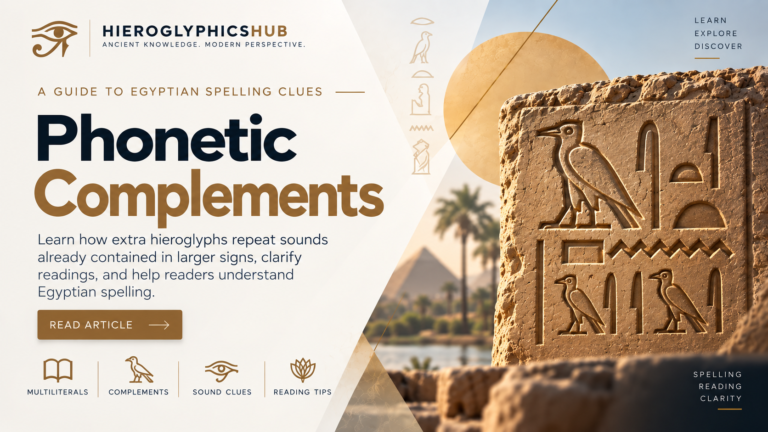
UCL’s worked introduction provides a useful case involving a multi-consonant sign with the value im. A separate one-consonant reed sign representing i appears beside it even though that consonant is already contained within im. UCL explains that such added signs could remind the reader of part of the larger sign’s sound value and could also contribute to balanced visual composition.
For the present topic, the key point is not the added sign itself. It is what the example proves:
Egyptian spelling can contain overlapping phonetic information.
You cannot simply add the values of every visible sign as though each contributed a new sequence.
The Most Common Beginner Error: Reading Every Sound Twice
Suppose a two-consonant sign has the value mn.
Now imagine that it is followed by the uniliteral sign for n.
A beginner might reason:
- biliteral = mn
- next sign = n
- therefore spelling = mnn
That conclusion may be wrong.
The final n can reinforce a consonant already contained in the biliteral rather than introduce a completely new consonant.
This is one of the most important consequences of learning multi-consonant signs.
A transcription of a hieroglyphic group is not produced by mechanically concatenating every possible sound value from left to right.
You have to identify how the signs relate to one another.
That makes Egyptian writing more structured than simple substitution.
Multi-Consonant Signs Also Explain Why a Hieroglyph Can Seem “Redundant”
Students often encounter spellings that appear unnecessarily repetitive.
Why would a scribe use a sign carrying two consonants and then write one of those consonants separately?
From an alphabetic perspective, it can look wasteful.
Within Egyptian writing, however, repeated phonetic information can help clarify the reading of a complex sign. UCL describes these accompanying one-consonant signs as frequent in Egyptian inscriptions and also notes that hieroglyphic groups were arranged with visual balance in mind.
So apparent redundancy can serve more than one purpose.
It may help the reader identify the intended phonetic value.
It may also allow the scribe to form a well-balanced group rather than leaving an awkward empty area.
This interaction between language and visual arrangement is characteristic of hieroglyphic writing.
It also means that two spellings of the same or related word do not have to look graphically identical in every inscription.
A Sign’s Phonetic Value Is Not Necessarily Its Meaning
Biliterals and triliterals become confusing when a phonetic value is mistaken for an English definition.
Take nfr.
The sequence nfr is a transliteration of consonantal information. In particular lexical contexts it is associated with meanings such as good, beautiful, or perfect, but nfr itself should not be treated as though the three transliteration characters are an English translation.
The same separation applies elsewhere:
phonetic value tells us what consonantal sequence a sign can represent.
lexical meaning concerns the Egyptian word being written.
sign function tells us what the hieroglyph is doing in that particular context.
Post 2 on hieroglyphic symbols and meanings explains why these layers should not be collapsed into a one-symbol-one-definition system.
With biliterals and triliterals, maintaining that separation becomes especially important.
Some Familiar Signs Can Carry Both Phonetic and Word-Level Information
Consider the offering sign associated with ḥtp.
UCL includes ḥtp among its examples of three-consonant phonetic signs. Current Unicode data also records the corresponding offering-table sign in relation to the Egyptian word for an offering.
These descriptions are not mutually exclusive.
The same hieroglyphic form can participate in the system through more than one linguistic relationship depending on use.
Likewise, 𓋹 is strongly associated with ꜥnḫ, “life” or “to live,” while also carrying that consonantal sequence.
This is one reason classifying Egyptian signs requires context rather than a rigid dictionary in which every glyph receives exactly one label.
When reading an inscription, identifying that a sign can have a value is only the first step. The surrounding word and grammatical context tell you whether that value is relevant in the occurrence in front of you.
How to Recognize a Biliteral or Triliteral in Practice
There is no visual feature that reliably announces:
“I contain exactly two consonants.”
A large sign is not automatically triliteral. A small one is not automatically uniliteral.
The classification depends on conventional linguistic value.
That means recognition comes from familiarity, reference materials, and repeated reading.
A practical process is:
- Identify the sign itself.
Use its Gardiner classification, Unicode entry, or a reliable sign list if you do not recognize it. - Check its documented phonetic values.
Do not guess from the object depicted. - Look at neighboring signs.
A following uniliteral may repeat part of the biliteral or triliteral rather than adding a completely new consonant. - Consider whether the sign is phonetic in this occurrence.
Some signs can also function as words, classifiers, or in other roles. - Read the complete word before deciding on a translation.
Consonantal decoding alone does not establish grammar or meaning.
This is also why the process described in our broader guide to reading Egyptian hieroglyphics moves from identifying signs to transliteration and then to language and context.
A Small Set of Multi-Consonant Signs Goes a Long Way
There are many biliteral and triliteral signs, and trying to memorize all of them at once is not an efficient starting point.
It is more useful to learn recurring signs while reading actual words.
A beginner might first become familiar with examples such as:
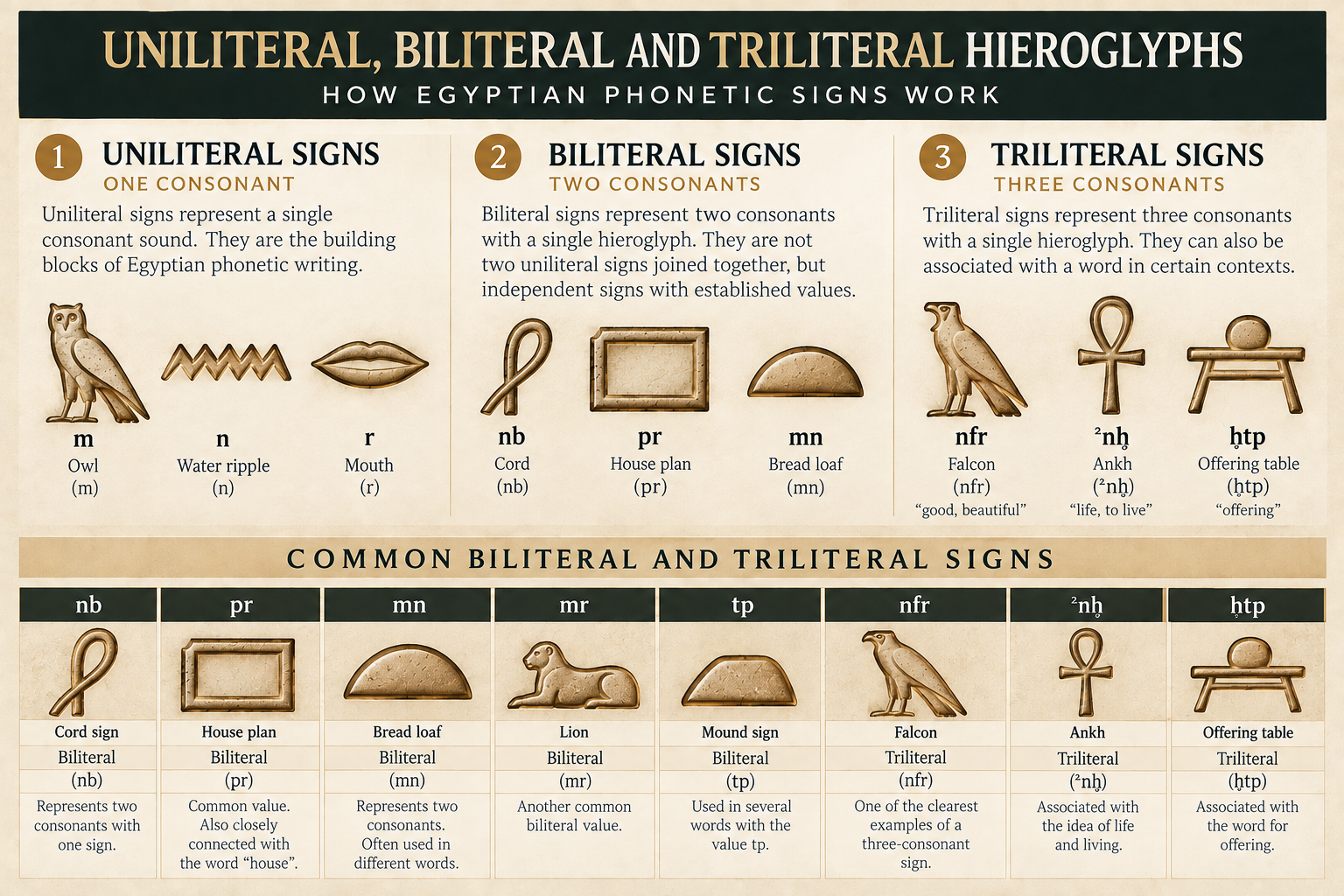
| Sign or value | Type | Consonantal value | Useful point |
|---|---|---|---|
| 𓎟 | Biliteral | nb | One sign supplies two consonants |
| House-plan sign | Biliteral | pr | Common value also closely connected with the word “house” |
| mn sign | Biliteral | mn | Shows how two sounds can be carried together |
| 𓄤 | Triliteral | nfr | One of the clearest examples of a three-consonant phonogram |
| 𓋹 | Triliteral/value associated with word use | ꜥnḫ | Demonstrates the overlap between phonetic value and lexical use |
| Offering-table sign | Triliteral/value associated with word use | ḥtp | Another case where sign function depends on context |
The purpose of this table is not to create another alphabet to memorize.
It is to make the scale of Egyptian phonetic signs visible.
Once you recognize even a handful of multi-consonant signs, real inscriptions begin to look different. Groups that previously seemed crowded or repetitive start to reveal an internal logic.
Why Letter-by-Letter Conversion Cannot Reproduce Egyptian Spelling
An English word can be approximated in hieroglyphs by selecting signs for its sounds. That is useful for modern names and educational exercises.
Ancient Egyptian spelling is a different problem.
A genuine Egyptian word may have a conventional spelling involving a biliteral or triliteral, repeated phonetic information, and a sign that clarifies meaning. Replacing every consonant with a uniliteral sign can therefore produce something that represents a sequence of sounds without reproducing how Egyptian scribes normally wrote the word.
This distinction matters when using the HieroglyphicsHub translator. The purpose of a language-aware translation is not simply to exchange Latin letters for attractive Egyptian symbols. Egyptian vocabulary and the writing conventions used to represent that vocabulary have to be considered together.
A technically possible consonant-by-consonant spelling is not automatically the historically appropriate spelling.
Biliterals and Triliterals Change the Way You Look at an Inscription
Before learning multi-consonant signs, it is tempting to view a hieroglyphic line as a sequence of individual symbols waiting to be converted into individual letters.
After learning them, that model becomes impossible to maintain.
One sign may carry nb.
Another may carry nfr.
A neighboring one-consonant sign may repeat part of a value already present.
A further sign may not contribute another spoken consonant at all.
The visible number of signs and the linguistic amount of information are therefore different things.
That is the real importance of biliterals and triliterals.
They show that the hieroglyphic system was not an alphabet decorated with pictures. It was a writing system in which signs of different phonetic sizes could operate together, sometimes with overlapping information, to create recognizable Egyptian spellings.
Learning the one-consonant signs gives you individual sound values.
Learning biliterals and triliterals teaches you how those values begin to behave as a system.


2 Comments