History of Egyptian Hieroglyphics: From the First Signs to the Last Inscription
Egyptian hieroglyphics were not created as a finished writing system and then left unchanged for thousands of years. They developed alongside Egyptian society, language, administration, religion, literature, and political power.
The earliest known Egyptian writing appears around the late fourth millennium BC. From those early inscriptions grew a writing tradition that would survive the rise and fall of pharaohs, changes in language, foreign conquest, Greek rule, and Roman rule. Hieroglyphic writing remained particularly important for monuments, temples, tombs, royal inscriptions, and religious texts even as other Egyptian scripts became more practical for everyday writing.
That long history matters because an inscription from the Old Kingdom does not necessarily represent Egyptian writing in exactly the same way as one produced during the Ptolemaic or Roman periods. The signs, conventions, language, literary traditions, and contexts changed over time.
Understanding that development makes ancient Egyptian inscriptions much easier to place in their historical context.
The beginnings of Egyptian writing
The origins of Egyptian writing belong to the Predynastic and Early Dynastic periods, before and around the unification of Egypt.
The earliest examples do not look like the long monumental inscriptions people usually associate with pharaonic Egypt. They include short labels, names, administrative references, and signs associated with people, places, goods, and institutions.
Around the end of the fourth millennium BC, Egypt was becoming more politically and economically complex. Written signs provided a way to identify objects, people, places, and quantities within an increasingly organized society.
The earliest writing therefore should not be imagined as a sudden invention of a complete hieroglyphic grammar. The evidence points to a system that expanded gradually.
Early inscriptions could be closely tied to the objects and scenes around them. Over time, writing became capable of carrying more information independently of the immediate physical context. Names and titles appeared in increasingly varied contexts, followed by more extensive expressions and eventually connected written discourse.
Research on the earliest Egyptian writing shows that complete clauses appear by the late Second Dynasty, while continuous texts developed during the Old Kingdom. That progression is significant: Egyptian writing was becoming not merely a collection of labels, but a means of recording language in increasingly sophisticated forms.
Early Dynastic Egypt: writing becomes part of the state
The Early Dynastic Period, conventionally associated with Dynasties 1 and 2, followed the political unification of Egypt around the beginning of the third millennium BC.
This was a formative period for Egyptian institutions, and writing became increasingly connected with administration, kingship, religion, and the organization of the state.
One of the important developments was the expansion of what could be written.
Early inscriptions had often focused on names and identifiable entities. During the Early Dynastic period, writing increasingly recorded titles, commodities, administrative entities, and other categories of information.
The visual appearance of signs also began to change according to how and where they were written. Ink-written signs could become more cursive, abbreviated, and focused on recognizable features rather than reproducing every detail of the object represented.
This distinction eventually became fundamental to Egyptian scribal practice.
The monumental signs carved into stone and the faster handwritten forms used by scribes belonged to the same broader Egyptian writing tradition, but they were not identical in appearance.
The development was already underway surprisingly early.
The Old Kingdom: hieroglyphic writing and monumental Egypt
The Old Kingdom, generally dated from the late third millennium BC, is the period associated with the great pyramid complexes, royal tombs, large funerary monuments, and the consolidation of Egyptian monumental culture.
Hieroglyphic writing became deeply integrated into that environment.
Stone architecture provided enormous surfaces for inscriptions. Tombs could contain texts connected with the deceased, offerings, titles, family relationships, religious beliefs, and the individual’s position within Egyptian society.
The royal pyramid complexes produced some of the most important early large-scale religious texts. The Pyramid Texts, first attested during the late Old Kingdom, represent one of the earliest substantial surviving bodies of Egyptian religious literature.
This period is particularly important because written Egyptian was no longer restricted to short identifying statements. Texts could form extended compositions with multiple clauses and more complex relationships between written statements.
Writing had become a durable component of Egyptian monumental culture.
But this did not mean that every Egyptian could read it.
Literacy was concentrated among trained specialists and members of administrative, religious, and elite institutions. Writing was a specialized skill requiring knowledge of the language, signs, conventions, and scribal traditions.
The impressive visual presence of hieroglyphs on pyramids and tombs can therefore be misleading to a modern observer. Their public visibility did not make literacy universal.
The First Intermediate Period: political change, continued writing
The end of the Old Kingdom was followed by the First Intermediate Period, during which political authority became more fragmented and regional elites gained greater importance.
Hieroglyphic writing did not disappear.
Instead, inscriptions continued to appear in local monuments, tombs, stelae, and administrative contexts. The political environment changed, but the scribal tradition continued.
This period is useful for understanding an important characteristic of Egyptian writing history: changes in political power did not automatically produce a complete replacement of the writing system.
Egyptian scribal culture had considerable continuity.
At the same time, the language and literary traditions represented in surviving texts could develop in different directions. The relationship between the spoken language, literary language, and traditional written forms became increasingly complex as Egyptian history progressed.
The Middle Kingdom: a period of literary and linguistic importance
The Middle Kingdom, particularly the Eleventh and Twelfth Dynasties, is often treated as one of the most important periods in the history of Egyptian language and literature.
Political reunification brought renewed central authority, while Egyptian writing continued to serve monumental, administrative, funerary, and literary purposes.
The Middle Kingdom is especially significant because the language associated with this period, Middle Egyptian, later became a classical written language.
Scribes continued to copy and study older literary works long after the Middle Kingdom itself had ended. British Museum evidence shows that Middle Egyptian literary texts were still being taught in scribal education centuries later.
This means that Egyptian written culture cannot be understood simply as a sequence in which one form replaced another and immediately became obsolete.
Older forms could remain authoritative.
A later Egyptian scribe might write in a language associated with an earlier period because that form carried literary, religious, or educational value.
The Middle Kingdom also provides strong evidence for the coexistence of different writing practices. The letters of Heqanakht, for example, were written on papyrus in hieratic during the early Twelfth Dynasty. This gives a useful reminder that hieroglyphs were only one part of the Egyptian scribal environment.
Hieroglyphs and hieratic were not competing languages
One of the most persistent misunderstandings about Egyptian writing is the idea that hieroglyphs, hieratic, and later demotic were simply three unrelated languages.
They were primarily different scripts used to write stages of the Egyptian language.
Hieroglyphs retained their distinctive visual character and were especially suited to carved and painted monumental contexts.
Hieratic was a cursive form of Egyptian writing designed for faster handwriting. Its signs became increasingly abbreviated compared with monumental hieroglyphs.
This made hieratic practical for documents, letters, accounts, literary texts, religious manuscripts, and other written material.
A useful comparison is handwriting and formal display writing in a modern language. The appearance can change dramatically without the underlying language becoming an entirely different language.
The distinction becomes especially important when studying Egyptian history because the surviving evidence is distributed across different scripts and writing surfaces.
A carved temple wall might preserve hieroglyphic text.
A letter on papyrus might preserve hieratic.
A later administrative document might use demotic.
All three belong to the much larger history of Egyptian written culture.
The Second Intermediate Period and the transition to the New Kingdom
The Second Intermediate Period brought another period of political division before the establishment of the New Kingdom.
Writing traditions continued through these changes.
The New Kingdom began around the middle of the second millennium BC and marked one of the most powerful phases of ancient Egyptian civilization. Egypt expanded its political influence, monumental construction intensified, and temples became major centers of religious and economic activity.
Hieroglyphic inscriptions became especially prominent in royal and temple contexts.
The surviving monuments of this period contain royal names, historical statements, religious texts, offerings, divine epithets, building inscriptions, and commemorative material.
At the same time, scribes continued to use hieratic for many practical and literary purposes.
This coexistence is one of the defining characteristics of Egyptian writing history. Hieroglyphic writing did not become the everyday handwriting system simply because it remained highly visible on monuments.
Different scripts served different practical and cultural purposes.
The New Kingdom: monumental writing at its height
The New Kingdom produced some of the most recognizable hieroglyphic inscriptions in existence.
Temples at places such as Karnak, Luxor, Abydos, and other major religious centers preserve extensive inscriptions from this period. Royal tombs and funerary monuments also contain large quantities of written material.
Hieroglyphs were particularly well suited to this monumental environment.
The signs could be carved, painted, arranged into columns or horizontal lines, integrated with images, and incorporated into architectural decoration.
Their visual character was therefore part of the communication.
An inscription was not simply text placed onto a building. The writing could participate in the overall composition of a wall, doorway, column, statue, stela, or tomb chamber.
The New Kingdom also demonstrates that Egyptian writing could be used in surprisingly different physical forms.
The Met, for example, preserves New Kingdom ostraca carrying hieroglyphic text, while other documents from the same broad period were written in hieratic with ink on papyrus.
The choice of script and surface depended partly on the purpose of the text.
A monumental temple inscription and a private administrative document did not need to look the same.
Language continued to change even when traditional writing survived
One of the most important points in Egyptian language history is that the persistence of traditional hieroglyphic writing does not mean the Egyptian language itself remained unchanged.
Egyptian developed through successive linguistic stages.
Older forms remained influential in formal writing even as spoken and written language changed.
This created an unusual relationship between tradition and innovation.
A later inscription could use an established hieroglyphic tradition while representing a later stage of the Egyptian language.
Likewise, scribes could preserve older literary compositions in traditional language long after the period in which those works were originally composed.
For modern readers, this is one reason an inscription cannot always be understood simply by recognizing individual signs. Its historical period can affect the language being represented.
Chronology is therefore part of interpretation.
The Late Period: tradition becomes a form of cultural continuity
After the New Kingdom, Egypt passed through several periods of political fragmentation and foreign rule.
Yet Egyptian religious and scribal traditions remained active.
The Late Period, particularly the Twenty-Sixth Dynasty and later periods, saw strong interest in older Egyptian traditions. Earlier artistic and textual conventions could be deliberately revived or maintained.
This was not necessarily a sign that Egyptian culture had stopped changing.
Rather, ancient forms could acquire additional significance precisely because they represented an established cultural tradition.
Hieroglyphic writing remained important for monumental and religious inscriptions while more cursive scripts served other functions.
The political rulers of Egypt changed repeatedly, but the visual language of temples and religious monuments continued to draw heavily on Egyptian traditions.
This helps explain why hieroglyphic inscriptions from later centuries can sometimes appear deliberately traditional.
The script had become more than a practical method of recording language. It was also part of the visual identity of Egyptian religious and royal culture.
Demotic enters the Egyptian writing landscape
By the first millennium BC, another Egyptian script had become increasingly important: demotic.
Demotic developed as a highly cursive form of Egyptian writing and eventually became widely used for administrative, legal, business, literary, and other types of documents.
The University of Chicago describes Demotic as both a script and a stage in the development of the Egyptian language. It became especially prominent from the Saite period onward and remained in use for roughly a thousand years, with different chronological and regional forms.
This development did not immediately eliminate hieroglyphs.
Instead, Egypt now had an increasingly differentiated writing environment.
Hieroglyphic writing remained strongly associated with monumental and religious contexts.
Demotic was particularly useful for practical written communication.
Hieratic also continued to have a long history, although its role changed as demotic became increasingly dominant for everyday written purposes.
The three-script landscape therefore tells us something important about ancient Egyptian society: the existence of multiple scripts was not evidence of confusion. It was a sophisticated response to different writing needs.
Ptolemaic Egypt: Egyptian and Greek traditions meet
Alexander the Great conquered Egypt in 332 BC, beginning the Ptolemaic period.
Greek became increasingly important in government and administration, while Egyptian writing traditions continued.
The result was a multilingual and multiscript environment.
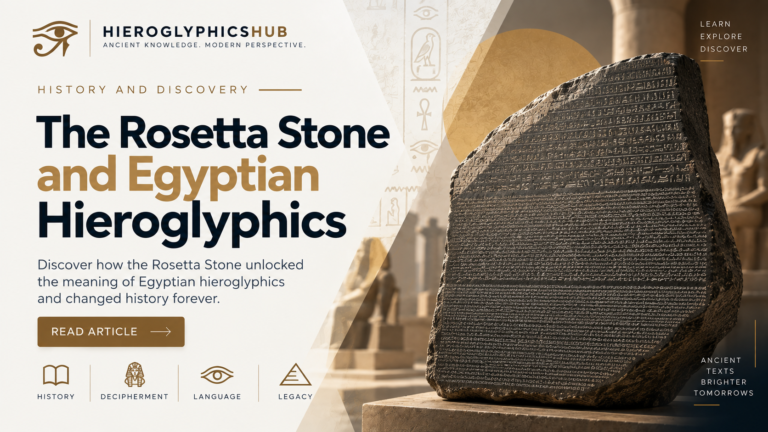
The Rosetta Stone, created in 196 BC during the reign of Ptolemy V, provides an especially famous example. Its decree appears in hieroglyphs, demotic, and Greek.
The three versions were not simply decorative repetitions.
They reflected the different linguistic and administrative audiences of Ptolemaic Egypt.
Hieroglyphs retained a prestigious role in monumental and priestly contexts. Demotic served Egyptian readers in more practical contexts. Greek represented the language of the ruling administration and the wider Hellenistic political world.
The Ptolemaic period therefore did not mark the sudden disappearance of hieroglyphs.
Quite the opposite: major temples continued to receive extensive hieroglyphic inscriptions.
Some of the monumental temples whose surviving decoration is so important for modern Egyptology were constructed or expanded during the Ptolemaic and Roman periods.
Hieroglyphic writing was still alive.
It simply existed within a much more linguistically diverse Egypt.
Roman Egypt and the final centuries of hieroglyphic writing
Egypt became part of the Roman Empire in 30 BC following the death of Cleopatra VII.
Greek remained extremely important, while Egyptian scripts continued to be used.
Hieroglyphic writing survived in temples and religious contexts for centuries after the beginning of Roman rule.
This is one of the most striking facts in the entire history of Egyptian hieroglyphics.
The script that had begun more than three thousand years earlier was still being carved by Egyptian priests during the Roman period.
But the cultural environment around it was changing.
Christianity spread through Egypt.
Traditional temple institutions weakened.
Older religious practices gradually declined, and the institutional settings that had sustained the traditional hieroglyphic tradition disappeared.
At the same time, new methods of writing Egyptian developed through the use of the Greek alphabet.
This eventually produced Coptic, an alphabetic form of Egyptian writing that incorporated Greek letters together with additional signs derived from Egyptian writing traditions.
The shift was therefore not simply from “hieroglyphs” to “nothing.”
Egyptian writing continued to evolve.
The older monumental tradition eventually gave way to newer linguistic and religious realities.
The last known hieroglyphic inscription
The traditional end point of hieroglyphic writing is remarkably precise.
The last known hieroglyphic inscription is a graffito at the temple of Isis on the island of Philae, dated to August AD 394.
By this time, the world in which hieroglyphic writing had flourished for thousands of years had changed dramatically.
The temple tradition was approaching its end, Christianity was expanding, and the older religious institutions were losing their position.
The Philae inscription is therefore more than a convenient final date.
It represents the closing stage of a writing tradition that had begun in the fourth millennium BC.
After this point, knowledge of how to read ancient Egyptian hieroglyphs eventually disappeared.
The signs remained physically visible on temples, tombs, statues, and monuments, but their linguistic meaning was no longer understood by later generations.
Egypt had not forgotten writing.
It had lost access to an older writing tradition.
Hieroglyphs did not simply “die out” overnight
The phrase “hieroglyphs disappeared” can make the historical process sound much faster than it actually was.
The decline was gradual.
Different scripts overlapped.
Different languages were used for different purposes.
Traditional Egyptian religious writing continued while new forms of Egyptian writing developed.
Greek became increasingly important, and later Coptic provided an alphabetic way to represent Egyptian.
The closing of temples and decline of traditional religious institutions removed an important environment in which hieroglyphic literacy had been maintained.
The disappearance of knowledge was therefore the result of a long cultural transition rather than a single event.
By late antiquity, the chain of scribal knowledge connecting later generations with the older hieroglyphic tradition had been broken.
The monuments remained.
The knowledge needed to read them did not.
What changed across more than three thousand years?
Looking at Egyptian hieroglyphics as a single unchanging system hides much of their history.
Across the long span from the earliest writing to the Roman period, several things changed simultaneously.
The range of written material expanded. Early labels and names developed into administrative records, religious compositions, literature, historical texts, monumental inscriptions, letters, accounts, and other forms of writing.
The language changed. Egyptian passed through different linguistic stages, even while older literary and religious forms remained influential.
Writing practices diversified. Hieroglyphic, hieratic, and later demotic served different contexts and purposes.
The physical environments changed. Stone monuments remained important, but papyrus, ostraca, coffins, stelae, statues, and other surfaces carried Egyptian writing.
Political circumstances changed. Egyptian rulers were followed by Libyan, Kushite, Persian, Macedonian, Ptolemaic, and Roman rulers, yet Egyptian scribal traditions continued through many of these transitions.
The cultural role of hieroglyphs changed. Their early development was connected with administration and political organization, while later monumental hieroglyphic writing became strongly associated with temples, religion, kingship, and cultural tradition.
The history of the script is therefore also a history of Egyptian civilization itself.
Why the age of an inscription matters today
Modern readers often encounter an Egyptian inscription as if every hieroglyph belonged to one timeless system.
Historical context changes that picture.
A short royal label from the Early Dynastic period, a Pyramid Text from the Old Kingdom, a Middle Kingdom literary inscription, a New Kingdom temple text, a Ptolemaic temple inscription, and a Roman-period graffito all belong to the history of Egyptian hieroglyphic writing, but they do not necessarily represent the same linguistic and cultural environment.
This matters when translating or studying an inscription.
The signs need to be considered alongside their date, location, genre, language stage, and context.
That is also why modern Egyptian language resources often distinguish historical periods rather than treating “Ancient Egyptian” as a single completely uniform language.
For anyone learning to read hieroglyphs, chronology is not background trivia.
It is part of the evidence.
From a living writing tradition to an archaeological language
For thousands of years, Egyptian hieroglyphs were part of a living scribal culture.
Scribes used them.
Priests maintained them.
Kings commissioned them.
Artists carved and painted them.
Administrators worked with related scripts.
Readers understood the language behind them.
The final centuries changed that situation.
By late antiquity, the institutions that had sustained the traditional writing tradition were disappearing. New religious and linguistic practices were becoming dominant, and the knowledge required to interpret the older monumental script was eventually lost.
For centuries afterward, the monuments of Egypt remained covered with signs whose meanings were no longer accessible.
The rediscovery of their language would come much later.
That story belongs to the history of decipherment rather than the history of the script’s development itself. The Rosetta Stone became central to that process, and the work of scholars such as Thomas Young and Jean-François Champollion eventually opened the way back into the written language.
For the story of how that happened, see Rosetta Stone and Egyptian Hieroglyphics.
The long life of Egyptian hieroglyphics
Egyptian hieroglyphics survived for an extraordinary length of time.
They began in the formative stages of Egyptian civilization and remained in use through the age of pyramids, the Middle Kingdom, the New Kingdom, periods of political division, foreign rule, the Ptolemaic kingdom, and Roman Egypt.
Their history was not a straight line.
The writing expanded, adapted, coexisted with other scripts, represented changing forms of the Egyptian language, and acquired new cultural meanings.
The final known inscription at Philae in AD 394 marks the end of the ancient hieroglyphic tradition, but not the end of Egyptian writing as a whole. Egyptian continued in new forms, eventually producing Coptic, while the older hieroglyphic monuments remained as physical evidence of a much longer written history.
Today, those monuments can once again be read because the lost linguistic knowledge was reconstructed by modern scholarship.
If you want to understand the wider subject before working with individual inscriptions, start with our hieroglyphics translator homepage, then explore the separate articles on how the writing system functions and how its decipherment was achieved.